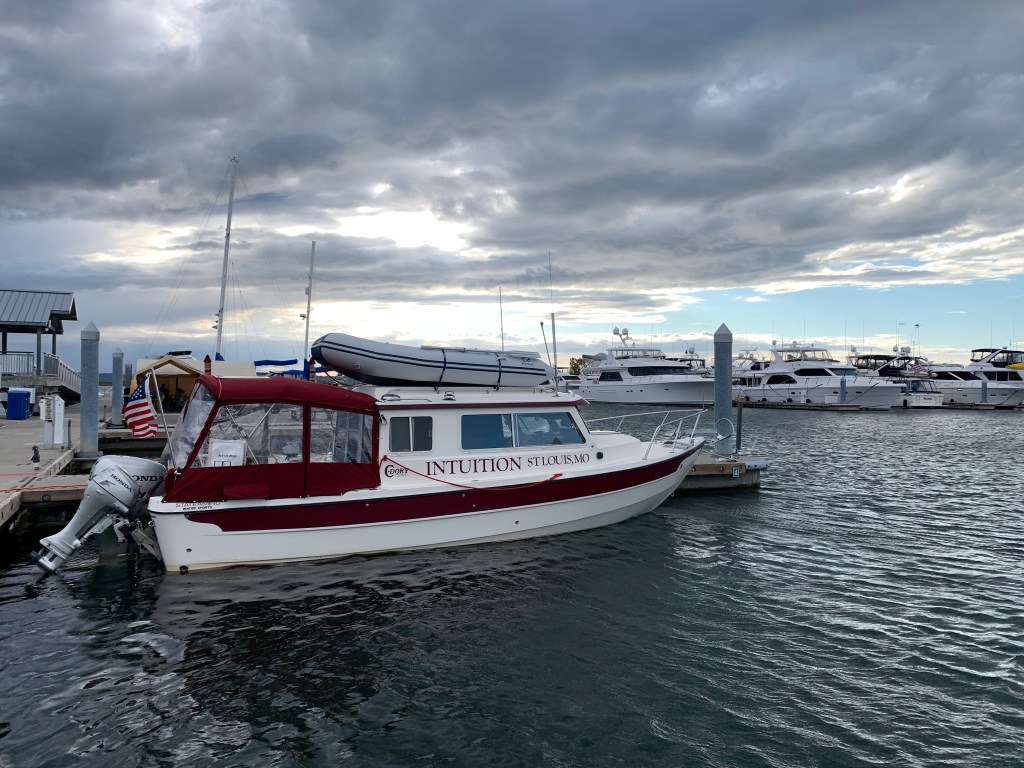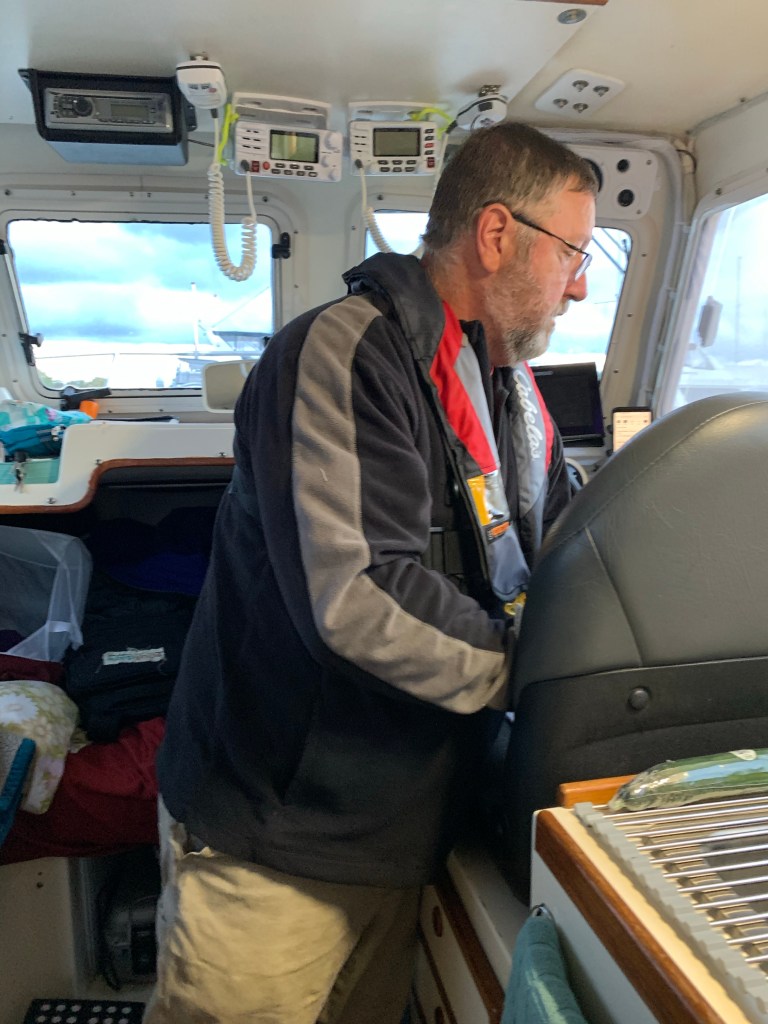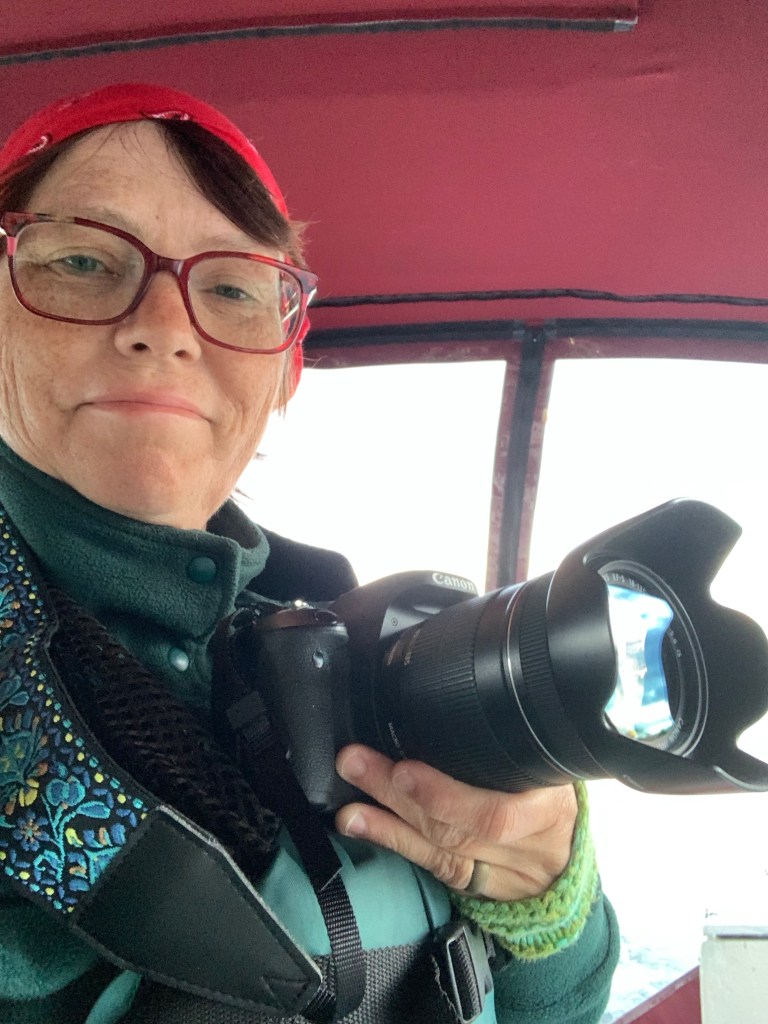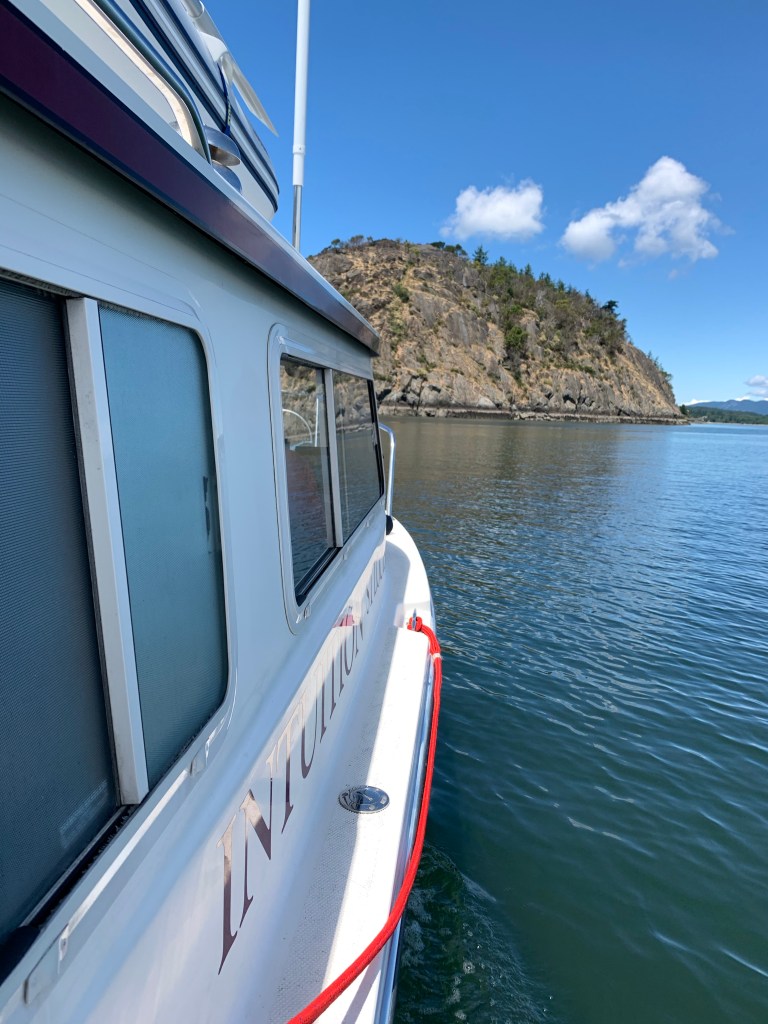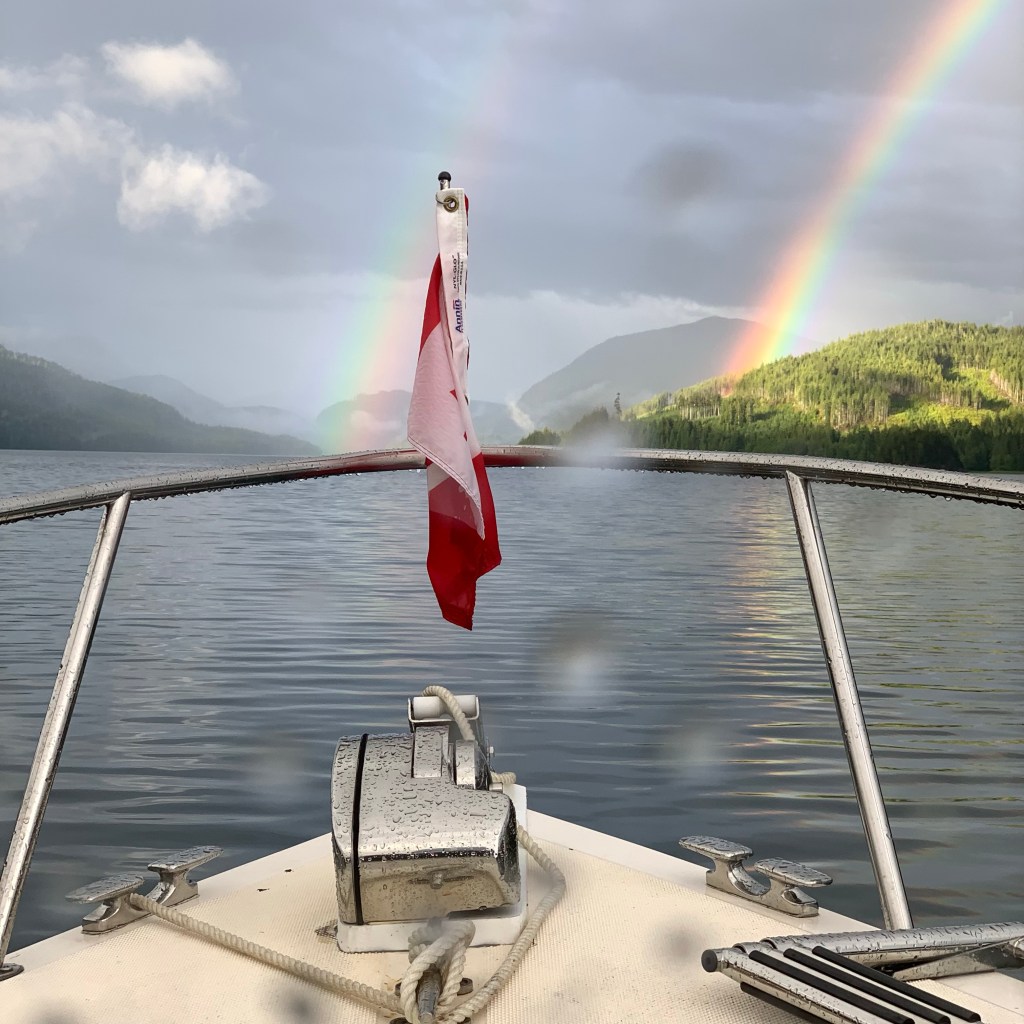
Days 7-9 (Henry Bay to Shearwater) June 14-16, 2021

Double rainbow punctuated our evening at Port Neville anchorage

Words by Les Rohlf Photos by Kel Rohlf

Les’ Log Notes for Day 7 (Henry Bay to Port Neville)

Total Distance: 98 miles

Total hours: 13.1

Left Henry Bay at 5:00am and slow cruised the entire way to Campbell River. The remainder of Strait of Georgia was very smooth, with only a slight chop near the end. While the gas gauge still showed half a tank, adequate for the next 100 or so miles to Port McNeill, we pulled into the Discovery Marina in Campbell River and added some gas. I still ascribe to the adage I learned as a young pilot – there are few things less valuable than runway behind you, altitude above you, and gas in the truck. This also allowed me to be more reckless with my fuel management later today, as I still wanted to make another 50 miles after going through Seymour Narrows.

We finished at the marina by 11:30, so had 3 hours to kill before the scheduled 2:30 low slack at Seymour Narrows. With the ebb running full force there were turbulence and wave in the channel along Campbell River a few miles prior to the narrows itself. We slowly cruised toward the narrows, looked into the entry, and then made slow circles for an hour and a half in the small harbor just east of Maude Island. At 1:30 a tug pulling an empty chip barge entered the narrows. Immediately after, the three larger cruisers who had been waiting followed. We entered at 1:50, 40 minutes early, and had a smooth ride through. 

Pushed up the power and ran on plane for the latter section of Discovery Passage and most of today’s run west through Johnstone Strait. With winds still out of the southeast, Johnstone strait had only a light chop. Our bigger challenge was fighting the flood tide, which seemed as high as 4 or 5 knots at Race Passage. Lots of swirls and turbulence there – I can imagine it would be a handful with a sailboat. We had a couple strong rainstorms during the last 15 miles, which required us to slow down and ensure we could see and dodge any logs. We pulled into Port Neville and anchored in 25 feet of water about a mile in from the entrance.

The weather window for the next couple days looks favorable. We’ll stop in Port McNeill for gas and a grocery drop, and hopefully anchor in a good place for the run around Cape Caution on Wednesday.
Les’ Log Note Day 8 (Port Neville to Clam Cove)

Distance: 84.3 miles

Total hours: 8.7

Woke up at 4:30 and looked outside to very thick fog, so went back to bed for a while. We left shortly before 8 when we had at least a quarter mile visibility. This was the first operational use of my horn connected to the Standard Horizon VHF’s fog horn functionality. It’s certainly annoying in a quiet anchorage, but at least safe and legal.

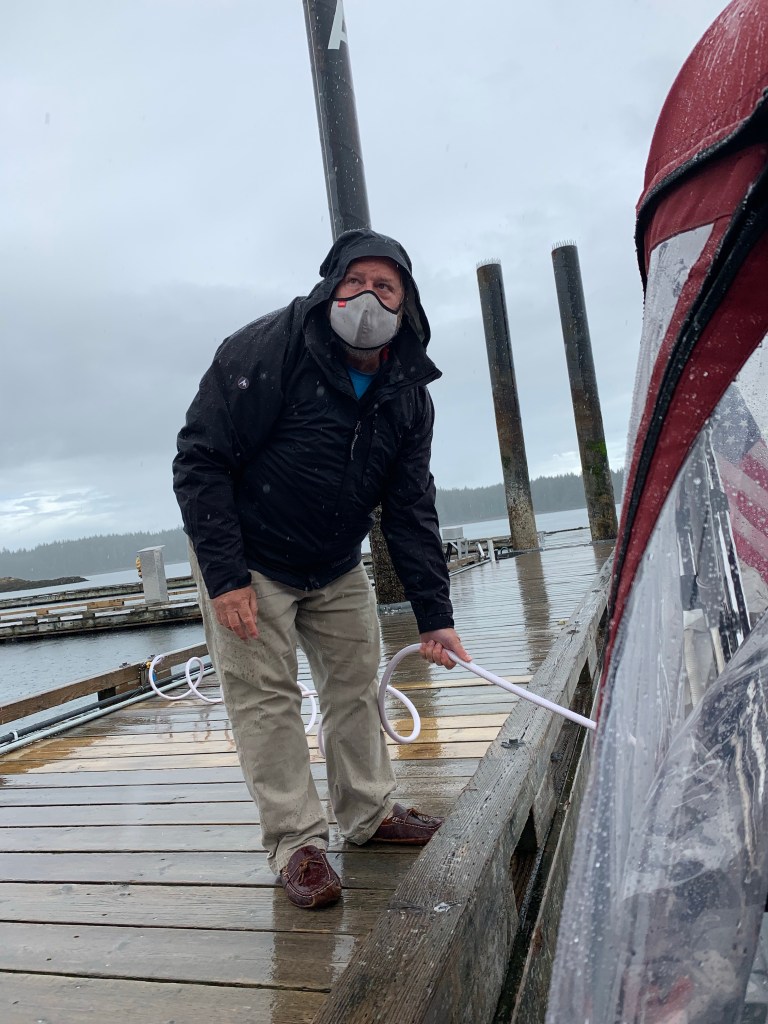
Visibility improved in Johnstone Strait, and the water remained smooth, so we cruised on plane (14-15 knots) most of the 48 miles to Port McNeill. We filled up with gas and water, and IGA delivered groceries we ordered a few days ago. Altogether a smooth stop for less than an hour.
We saw our first otters in Goleta Channel outside Port Hardy this afternoon. (Photo held up by the internet lol)

We’re staying in Clam Cove tonight. It sits on the NE side of Nigei Island opposite Port Alexander. The entry looks daunting, but we had plenty of water all the way in. The inner cove includes several floating homes – a very interesting and protected anchorage.

Clam Cove floating homes

I hooked up and ran the generator for hot water for showers tonight, because… it was time. It takes about 20 minutes to heat up 2.5 gallons of water – enough for one quick warm shower.

Les’ Log Notes Day 9 (Clam Cove to Shearwater)
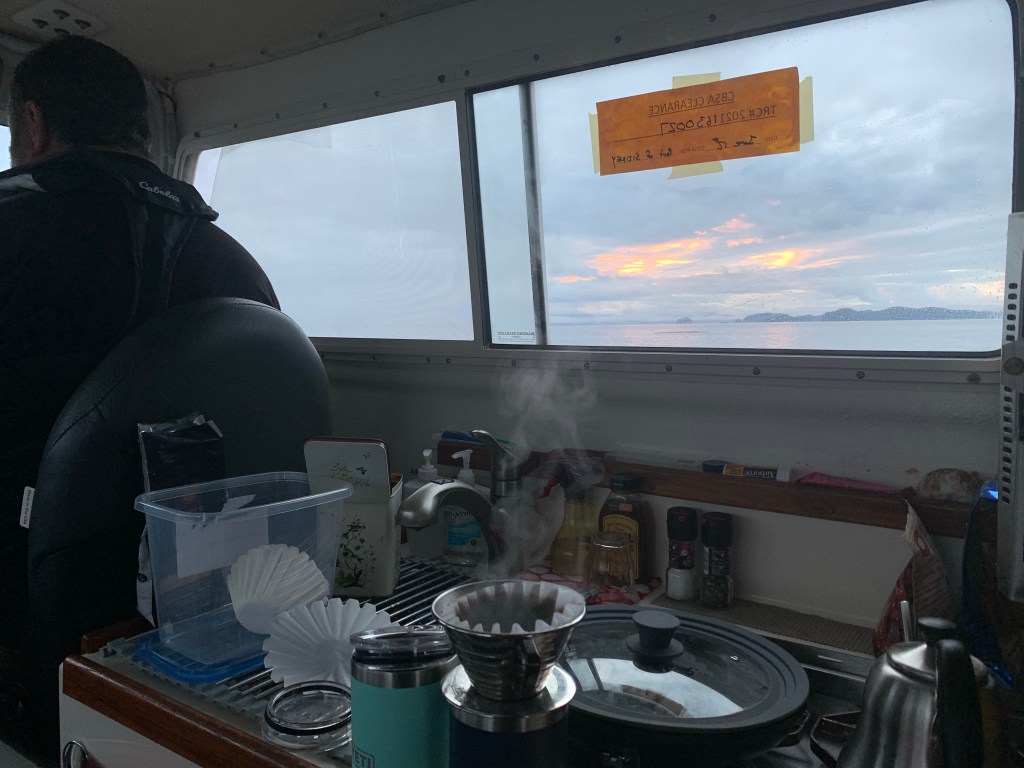
Making coffee and watching sunrise as we leave Clam Cove

Distance today: 102 miles

Total hours: 7.3

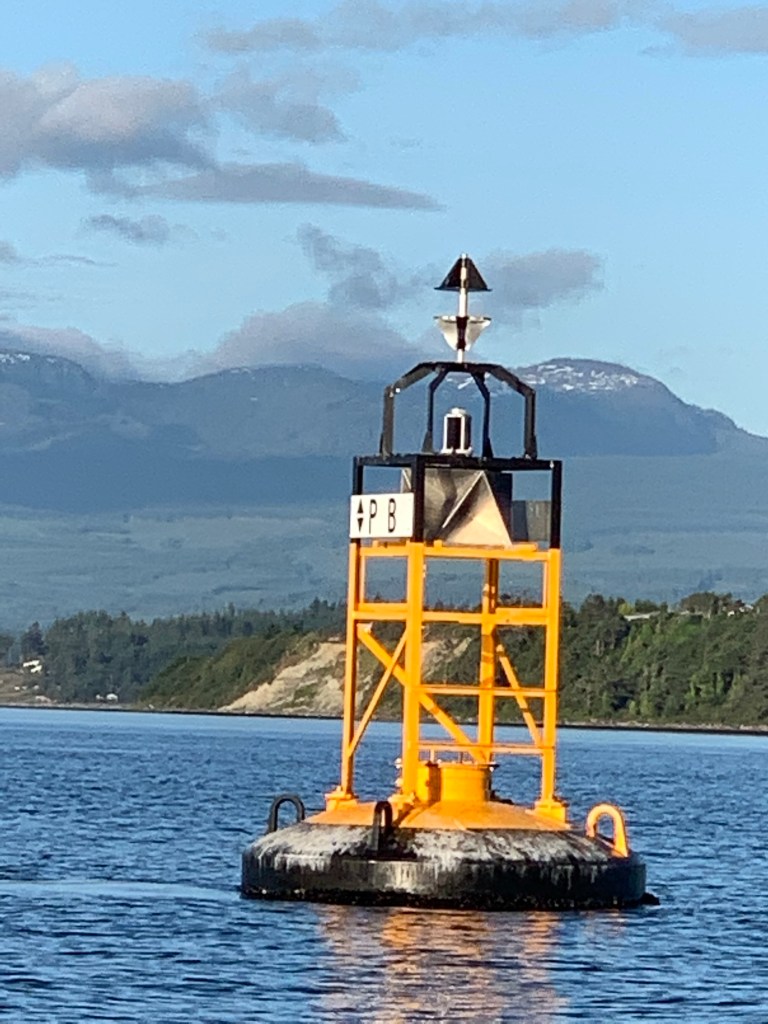
We woke at 4:30 and were moving from the anchorage at 5:00. No cell connection at this harbor, so listened a couple times to the weather broadcast on VHF and didn’t hear any new or different info. Observations at Pine Island and Egg Island seemed pretty tame, and the West Sea Otter buoy indicated waves less than a meter, so we headed out of Clam Cove through lots of debris in the entrance.

We entered Gordon Channel, pointed toward Pine Island, and pushed up the power to start our run across the smooth water toward Cape Caution. Almost immediately, the engine overheat warning sounded (YIKES!!). I stopped the motor and went back to investigate. In retrospect, perhaps I should have left the motor idling for another 20 seconds to verify the motor wasn’t “peeing” rather than assuming that was the issue. There was one of those long snake-like weeds wrapped around the prop and some other debris at least partially blocking the cooling intake screens. After cleaning everything off, restarting the engine, and verifying the cooling stream, we ran at lower RPM for a few minutes without issue. I tentatively pushed the power up again, and the motor responded fine. It hummed along without hesitation for the next several hours at 4200-4400 rpm as we crossed the strait and made our way up Fitz Hugh Sound. As background, we generally tilt the motor up at night to limit the chance of snagging something at anchorage. We verify everything’s clear before tilting it down and starting each day. Since the prop was clear when we left, we suspecty the debris was picked up when we left Clam Cove into the main channel.

With winds still light out of the south and southeast, along with the beginning of the ebb tide, the run to Cape Caution was fairly smooth – mainly light chop on top of some low swells. We rounded Cape Caution at 7:00, where the ride became smoother. Fitz Hugh Sound was choppy until we passed Burke Channel. It was only 11:00 when we arrived at the cut-off to my planned anchorage at Codville Lagoon, and Kel suggested we continue farther. We arrived in Shearwater about noon, got some more gas and water, and anchored in the adjacent bay where we there’s good cell coverage and we can satisfy our electronics habit.  

By the way, what’s the appropriate name for that creepy top-of-the water plant that looks like an eyeball on top of the water, has a long, snakelike body, and  in some cases, a leafy, beard-like section that extends deeper below the water? I want to call it eelgrass, but I know it’s not that. I had a big one wrapped around the anchor when we retrieved it this morning, and the snakey section of one wrapped around the prop when the overheat warning went off.

Thanks to everyone for your generously sharing your encouragement, wisdom, and recommendations with us. We really look forward to (hopefully) being able to take a more leisurely return through BC in a couple months, as it feels like we’re missing a great deal by just “passing expeditiously through”.

Whenever the rainbow appears in the clouds, I will see it and remember the everlasting covenant between God and all living creatures of every kind on the earth.” (Genesis 9:16 NIV)
Days 3-6 (Roche Harbor to Henry Bay) June 10-13, 2021

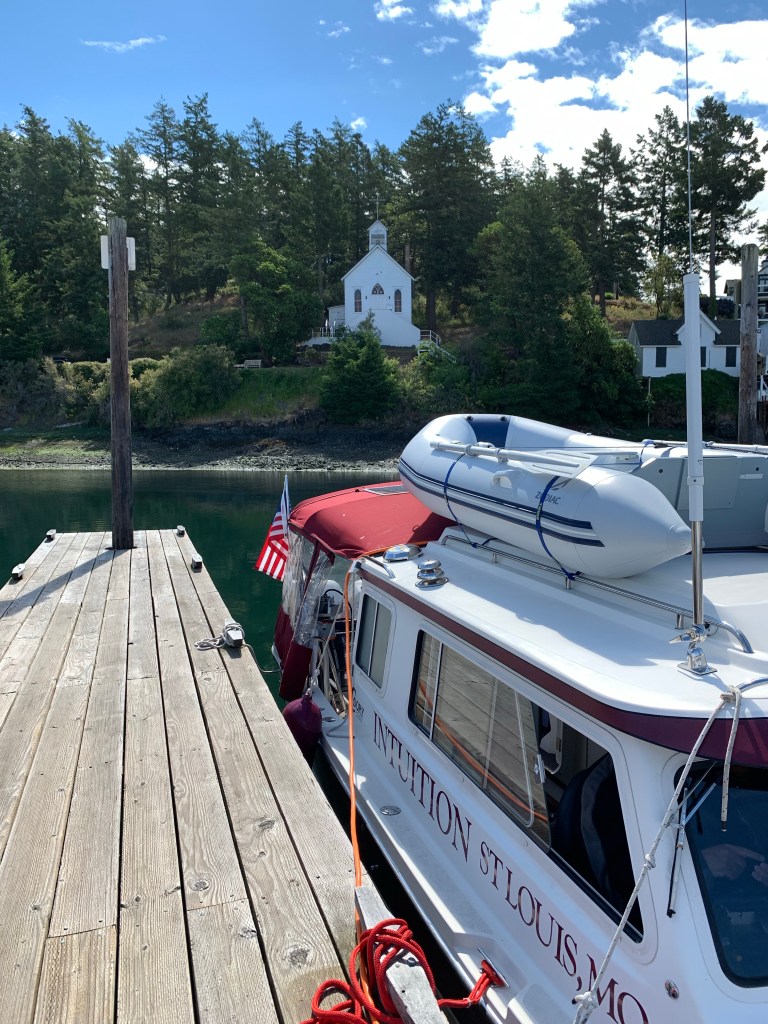
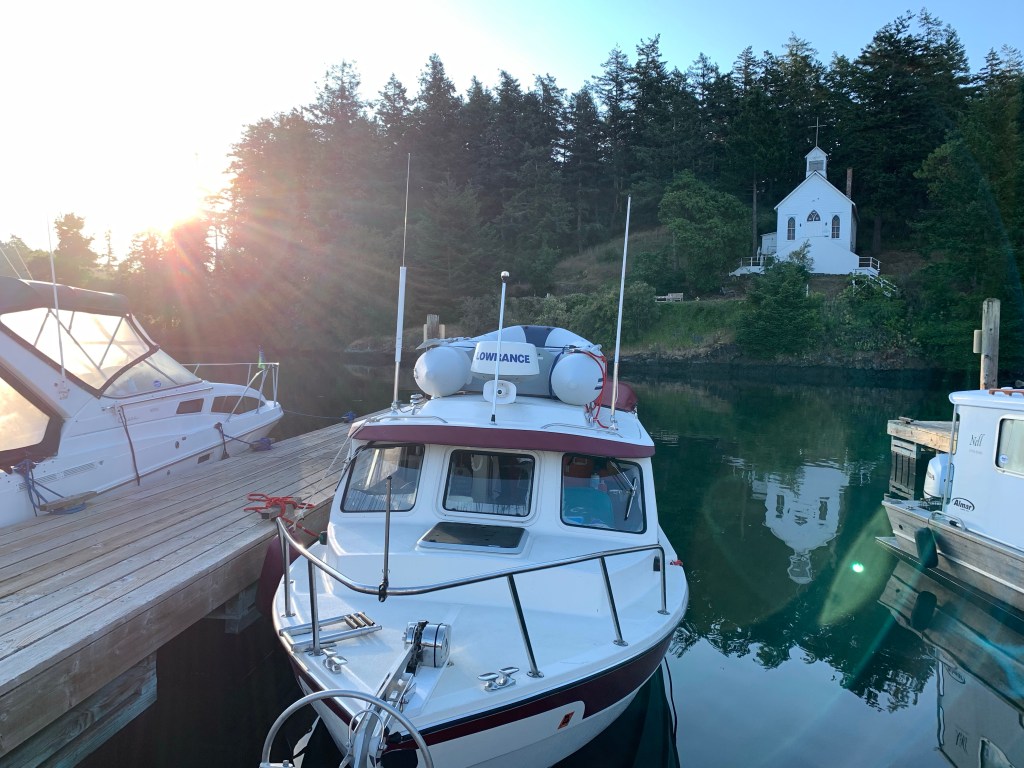
Roche Harbor, WA under the watch of Our Lady of Good Voyage Chapel

Roche Harbor, WA

We called into Roche Harbor Resort marina on Thursday at 8:30am to see if they had a slip available; we were assigned slip 42B on the guest dock, under the watch of “Our Lady of Good Voyage Chapel.” We were able to top off with gas first, and then directly go to our slip by 9:00am. The resort is a quaint nook on the northern shore of San Juan Island, established in the 1880s as a Lime and Cement company site, then the property later became a resort. One of the highlights of our stay at Roche Harbor was a pleasant walk around the San Juan Islands Sculpture Park, with 19 acres of natural landscape adorned with sculptures. We enjoyed eating at the Lime Kiln café, and had Starbucks coffee with breakfast one morning. We ended up staying an extra day, and so we got all our walking, showering, dining out and shopping needs met before heading to Sidney, our entrance port into British Columbia, Canada.

As we mentioned, we will be able to stop for gas and have groceries delivered, but no sightseeing ashore or overnights at marinas in Canada. The next leg of the trip will be meals on the boat, with no fresh fruit, fresh meat or eggs from Washington. Customs does not allow you to bring certain items into Canada. We can get fresh fruit, fresh meat and eggs in Canada, however we must eat it all before passing through U.S. Customs in Ketchikan, Alaska. Lots of protocols, but we were prepared, as Les diligently researched the regulations before we left.

I bought some souvenirs and snacks in Roche Harbor to bring along. I found a nice zippered hoodie jacket and a baseball cap. It’s chilly, and although I didn’t need another jacket, it was a useful souvenir. The baseball cap will keep the sun out of my eyes. (Yes, the sun does shine in the Pacific Northwest.) Our first rain was on Friday, while at Roche Harbor in the afternoon, but by dinner it was sunny and pleasant again. We stayed the extra day because the weather station issued a high wind warning, which translates into rough seas. We do not enjoy rough seas. Instead, we enjoyed the evening watching other boaters walk along the docks, and ordered juicy burgers from the café for dinner.

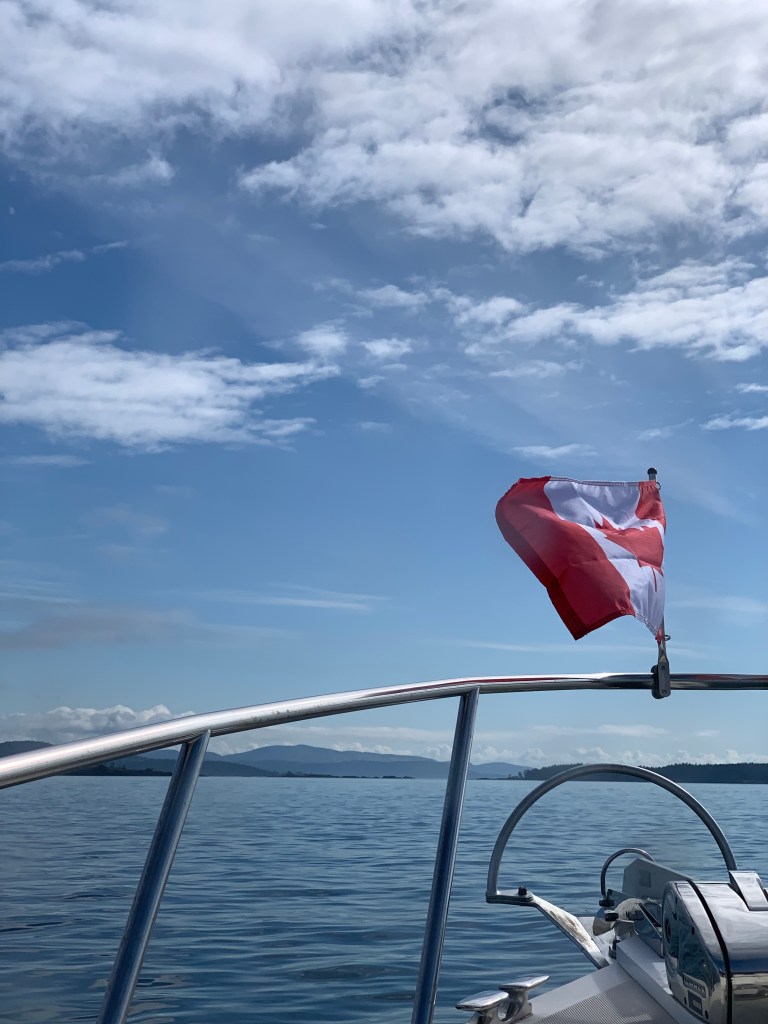
After passing through Canadian customs, we fly a courtesy flag of the welcoming country

Sidney, Canada and Northwest Bay anchorage

Saturday morning, we slept in a little and had breakfast on the boat. We were underway by 6:30am. It was a very calm and idyllic morning. The customs check-in was 12 miles across the Haro Strait, which we arrived at by 8:30am. We called in to the customs to give our information, then by 8:55am, we were greeted by two officers, who checked our passports, asked us questions and wished us well on our journey. We left by 9:30am to head toward our first anchorage in Canadian waters.

(Les’ thoughts will be in Bold Italic throughout the trip)

We followed Captain’s Passage west of Prevost Island, then up the Trincomali Channel west of Galiano Island. We realized we would not be able to hit the 11:45am slack at Dodd Narrows, so we pushed up the power and arrived at Porlier Pass for its noon slack. After listening on the VHF radio to all the mayhem at Dodd Narrows (lots of boats trying to pass through a narrow strait at the same time) it’s probably best we weren’t there. We slowed a little for two tugs pulling logs and rock through Porlier Pass, then went through without incident.

The Strait of Georgia welcomed us gently, with winds out of the ESE and waves of no more than a foot. The waves were on the beam for the first seven miles, but after turning more westerly at Gabriola Island, the seas became following and the ride smoothed for the rest of the day. As the flood tide kicked in, we got a little boost of speed as well. All in all it was a good day, good progress and cooperative weather.

When we arrived in Northwest Bay, Les asked me to take the helm. Earlier our starter battery failed again, same problem with the fuse. Les fixed that while I slowly circled around the bay amazed at the mountains surrounding us. We dropped the anchor using our windlass, and were settled by 6:00pm. I made mac and cheese with tuna and canned peas. We ate our meal and enjoyed canned pineapple for dessert. After dinner, Les prepped the charts for Sunday’s cruise and I sat on the “back porch” to write in my journal, and sit in awe of the mountains some more. A family stood on the beach, looking out at the view as well. How wonderful to look at this scenery on a daily basis!

Before bed, Les listened to the “lady” on the automated weather forecast out of Victoria. She spoke of winds, directions, and wave heights. I found it interesting that she pronounced southeast as “soth” east with a long “o” sound.

Les listened carefully, and double checked the report on windy.com; he informed me that we should set the alarm for 4:00am to get an early start to beat the winds. I announced that I better go to bed. It was 8:30pm and still light out. I put on my eye cover mask, and amazingly fell sound asleep.

Henry Bay, Denman Island, British Columbia

Our first anchorage north of Nanaimo, BC

Les climbed out of bed with the 4:00am alarm. I stayed under my cozy covers, half listening to the weather lady, wondering if the weather would be favorable for our proposed early start. We decided that it would probably be a little choppy out on the main strait, so we made coffee in the bay and left by 5:25am. We hoped to cover 80 miles. The plan was to make a quick run to Henry Bay, and anchor out for the morning until the afternoon, and then cruise up the remainder of the Strait of Georgia. The morning ride was a lot lumpier than we expected. Les valiantly rode the waves, and I tried to take a photo or two. I told myself not to read or do too much looking because the roiling waters tend to overtake my stomach. (I’ve never been truly seasick, but am prone to a little motion sickness now and again.) I didn’t listen to myself, and kept taking photos, looking through the binoculars, checking the map. Finally, I realized that wasn’t going to work. So I laid down in the berth to ride out the nausea. In the meantime, the boat got side whacked by a wave and drawers fell out. As the waves continued to be wrangled by Les T the helm, other items fell on the cabin floor from various perches. I watched from my nest in the berth, and understood what the phrase, “batten down the hatches” meant. Les remained at the helm, and periodically leaned over to the berth to tell me, 10 more miles, 5 more miles, almost there.

As we drew closer to the bay, I felt a little better and righted some of the fallen items. When we got to the bay, I felt good enough to witness and take a short video of the first launch of the anchor with our windlass from inside. (The first time Les had to go out on the bow to unlatch a cotter pin, but after that we left it unlatched so as to be able to lower it from inside. A very nice benefit.) I woke up wanting to bake something. So I finished stowing fallen items, and pulling out my Omnia stove, which acts as an oven on the stovetop. We had better data service, so I looked up recipes and was so inspired that I also made chicken and rice in our small crockpot, using the solar battery to power it.

In the meantime, Les had been listening to his favorite lady about weather, checking Environment Canada’s forecasts and buoy reports. It sounded like we’d need to stay put, instead of trying to slog it out with even higher winds, which equals higher waves (It’s a theme.) I was happily cooking, and a little relieved that we’d get another day to pause. Our pace has been rigorous, not because we have a timetable, but I think more so, because we’re both so excited to get to Alaska. Weariness, weather and wisdom prevailed. I baked muffins and Les decided to take a nap. We ate a hearty lunch of chicken and rice with the muffins. We watched the day pass by, as other boaters joined our anchorage in this quiet little bay. Sailboats to one side, and power boats to the other, by design or default? Who knows? But those are the details that will become mundane, as we travel further along on the waterways.

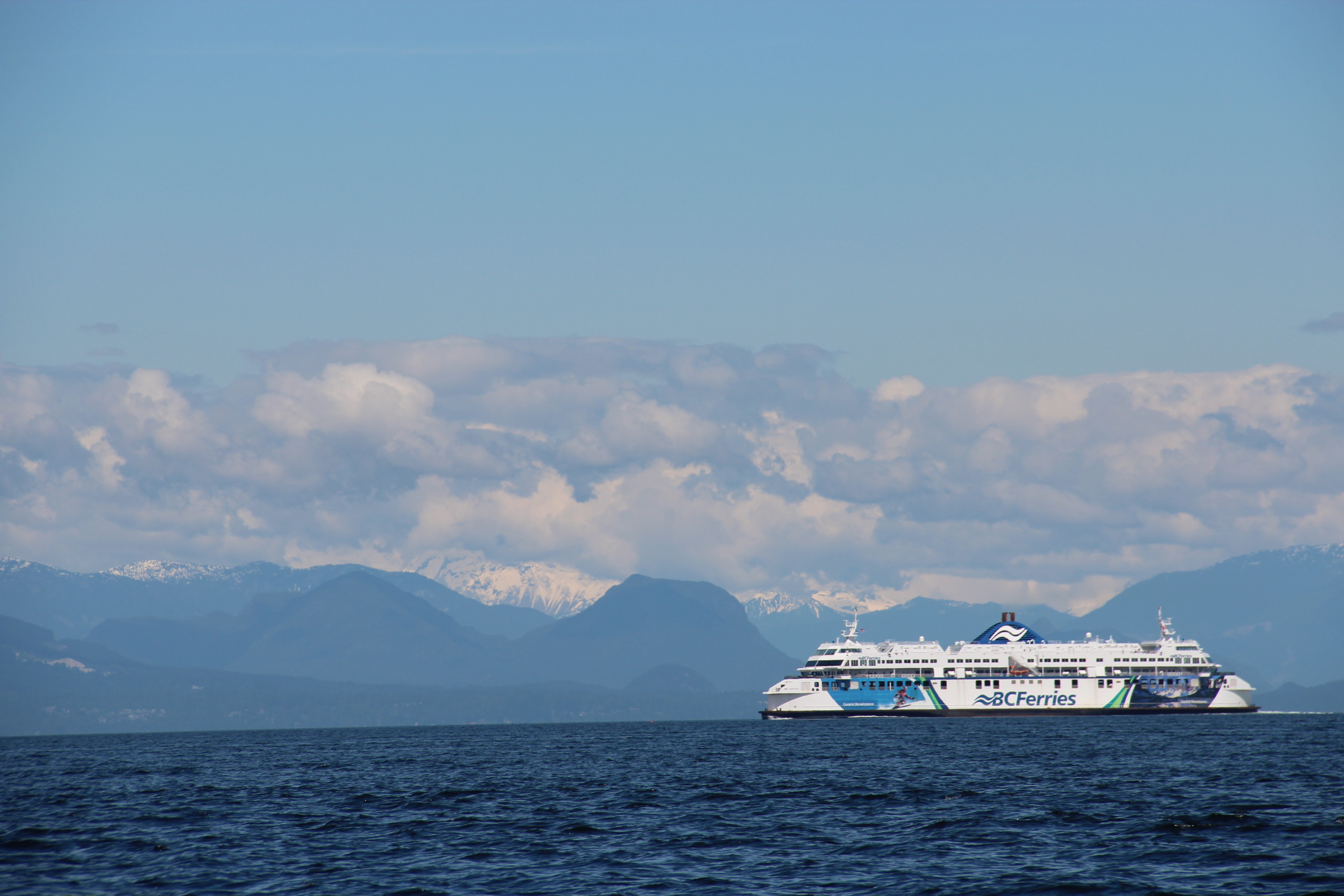
(Photos below from our cruise from Sidney to north of Nanaimo

A sign that we are in British Columbian waters
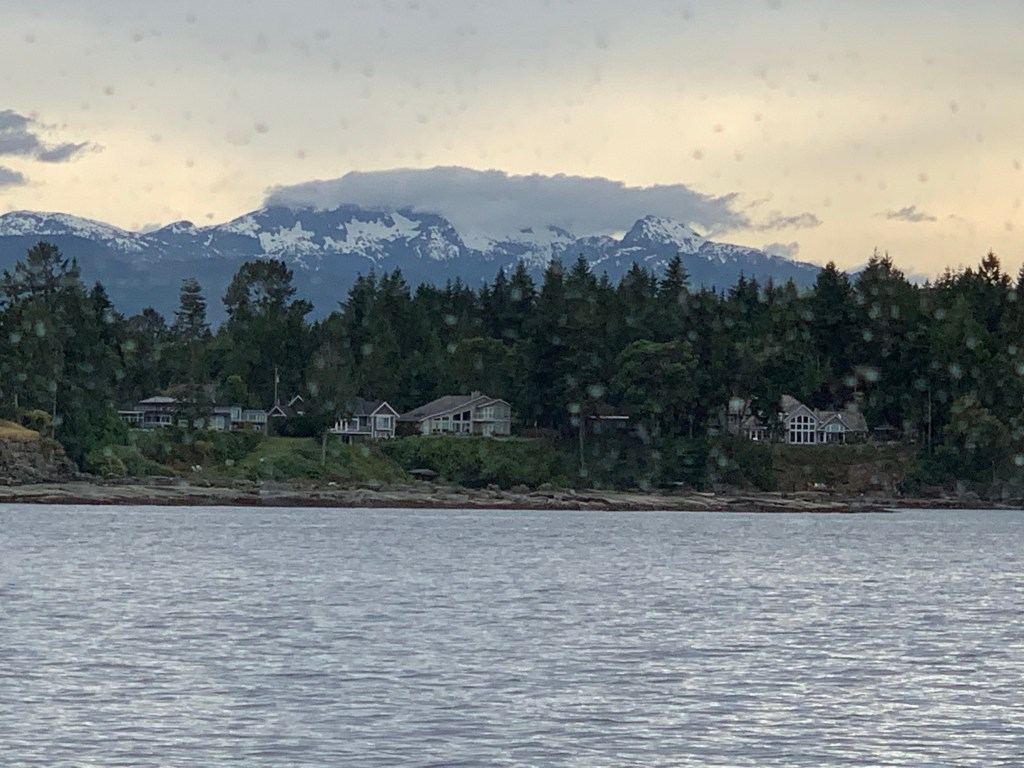
The Canadian mountains are spectacular
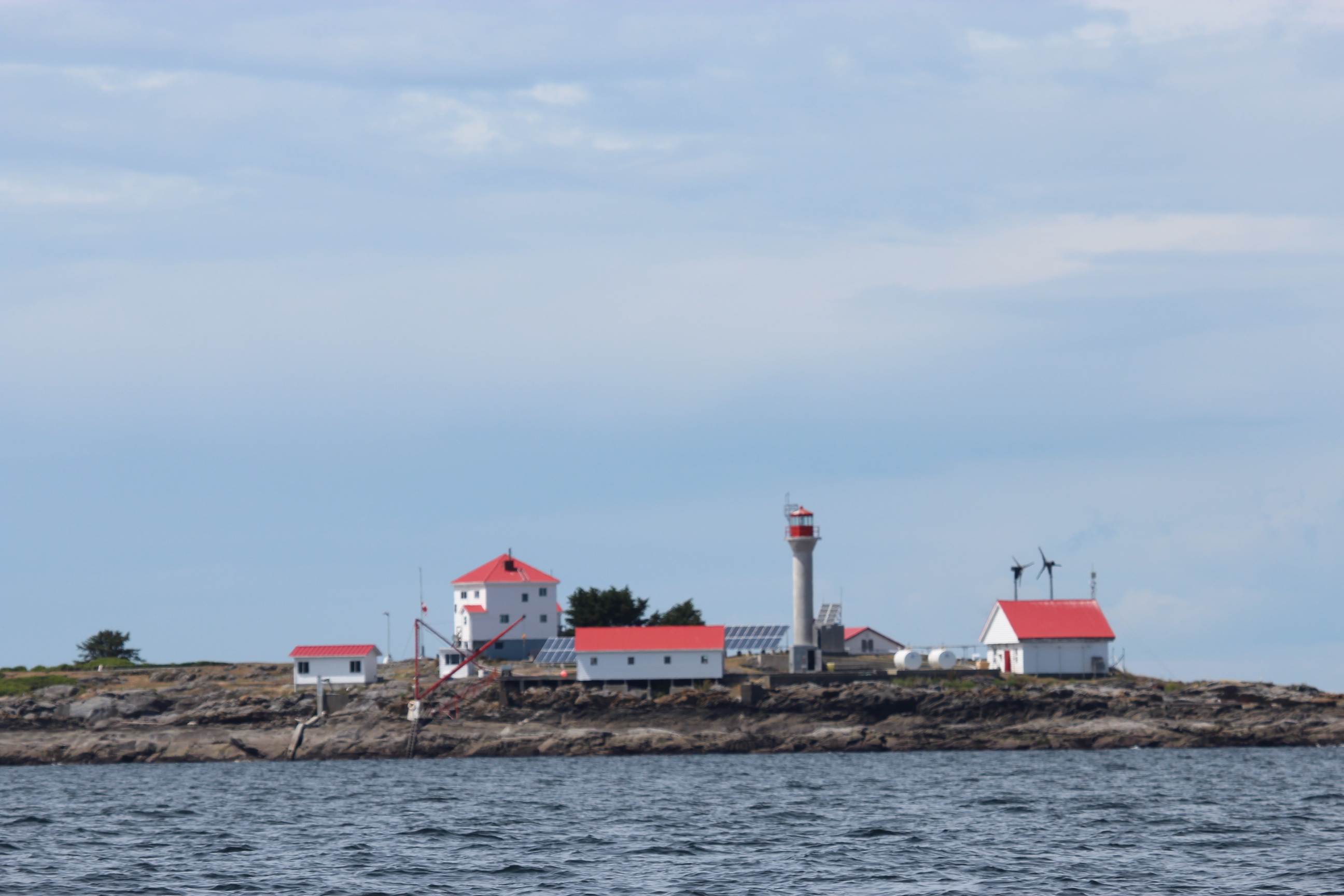
Light Station at Entrance Island, BC

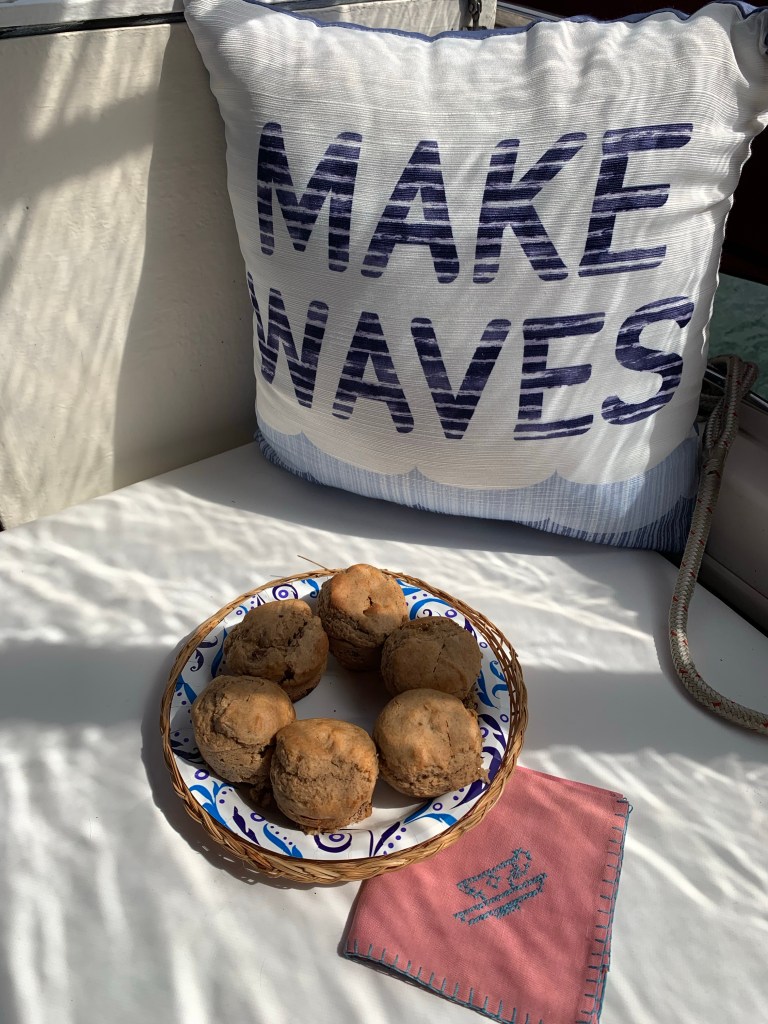
Recipe for Lemon-Ginger Cherry Muffins

Baking and making life cozy at Henry Bay, BC
  • 2 cups Bisquik
  • 2 chopped Gummy Bear brand Ginger Lemon candies
  • 1t to 1T cinnamon
  • 1/2 t ginger
  • Pinch of cardamom, nutmeg and ground cloves
  • 1/2 cup dark brown sugar
  • 1t oil or 1 egg
  • 3/4 cup skim milk

Mix ingredients together in order. Scoop into greased muffin tin. Bake for 12-15 minutes in a 350F oven. Makes 6 muffins.

“Applause, everyone. Bravo, bravissimo! Shout God-songs at the top of your lungs! GOD Most High is stunning astride land and ocean. (Psalm 47:1-2 The Message)

Firsts (Port of Everett to Roche Harbor Resort)

Docked at Port of Everett, WA
Les going over checklist for our first launch out into Puget Sound

Days One and Two (Port of Everett to Roche Harbor) June 9-10, 2021

Our first day out on the water, we took the recommendation of other seasoned sailors and woke with the sun. We checked the weather report. Deftly went through our checklist, unhooking shore power, switching from house batteries to the starter battery, starting the motor, and then unmooring and gently leaving our slip, with plans to cruise from Port of Everett over to Anacortes.

First problem, Les noticed that the starter battery acted as if disconnected. Add it to the fix-it list, he tells me and turns the battery back to the house battery, which works as a backup when the starter battery fails. The motor fired up, and we walked through me untying and holding the lines, while Les backed us out and I simultaneously hopped aboard and stowed the ropes. Once we were clear, we navigated out of the guest dock, and into the harbor past a moored container ship, and a tug making an early run south to the Seattle area. It was 5:30am.

We looked at each other as we started crossing Possession Sound and said, “Good morning!” The water was relatively smooth, so I started making our coffee and oatmeal for breakfast. Our first day included going 53 miles and stopping for the day at the Cap Sante marina in Anacortes. The pine tree lined shore and occasional harbor seal popping its head out of the sea delighted us. We started out slow, and then when we had some open water we pushed up the power for an hour or so to make good time. We made it to our port exactly at 1pm, which was the check-in time. The day was sunny and in the 70s, we had yet to see any rain, instead billowing white clouds added drama to the beautiful scenery along the shore.

Once we checked into the marina, we walked to Safeway to get a few last minute groceries; our next opportunity to get groceries will be in Port McNeill in Canada. On the way to get groceries, we spotted a cute hot dog stand, and had a late lunch first. As we walked down Dock M back to our boat, we met our first dock friends, Bruce and Paula from Idaho. They were enjoying their happy hour and admiring at our boat. They were celebrating their 50th anniversary, and were reminiscing about their sailing days, and the C-dory his dad used to own. We exchanged boating adventures, and bits and pieces of our life stories. It was refreshing to have a relaxed conversation, as the cool breeze with the sunshine made for a pleasant time out of doors.

One of the joys of boating is meeting new people, who share a common interest. Another first on this trip, was meeting Kristen in the laundry room at Port of Everett. (Les and I planned to get some laundry done before making the trip up to Ketchikan, Alaska, which will cover 750 miles and take about 10 days if we have a good weather window.) While Kristen and I talked about her boat life and her sweet dog. While we were chatting, Dawn arrived. She was having a frustrating day because the other laundry room’s washers and dryers weren’t working. We commiserated, as I had trouble getting a shower earlier. The laundry and showers are activated by credit card, and I couldn’t get any water to turn on after I swiped the card. It was lovely to meet two women who lived on their boats full time, and were enjoying life to the fullest. They inspired me.

Once again we woke up with the first light of the day, to make our way to San Juan Island, leaving port at 5:15 am and arriving at the Roche Harbor marina by 10am covering 36 miles. The winds are supposed to pick up tomorrow, and our small boat gets pretty battered by waves that come abeam the boat when crossing a bay. We need to get to Sidney, Canada to check in before we cross from Washington waters to Alaska waters. On the Canadian leg, due to travel restrictions, we are allowed to cross their waters, with the limitation of no leisure activities and no getting off or mooring at marinas. We can anchor out in Canadian waters. We can stop for fuel and have groceries delivered. It will be our first time going through this process, so we don’t want to be fighting weather and the stress of a new situation. So we will keep checking the weather and wait it out to go at the most favorable time.

Today, we continue to have a sunny day and in the 60s. We had our first fish and chips for lunch, then walked to a cool sculpture and nature park. Tomorrow, we will wait for our first encounter with potential “snotty” weather. If it’s too windy, we’ll just stay another night here at Roche Harbor.

To keep up with our adventures, consider subscribing to the blog to get updates in your email. Also check out Kel’s Facebook page where she often posts photos of the trip.

Kel hoping to capture her first photo of a whale
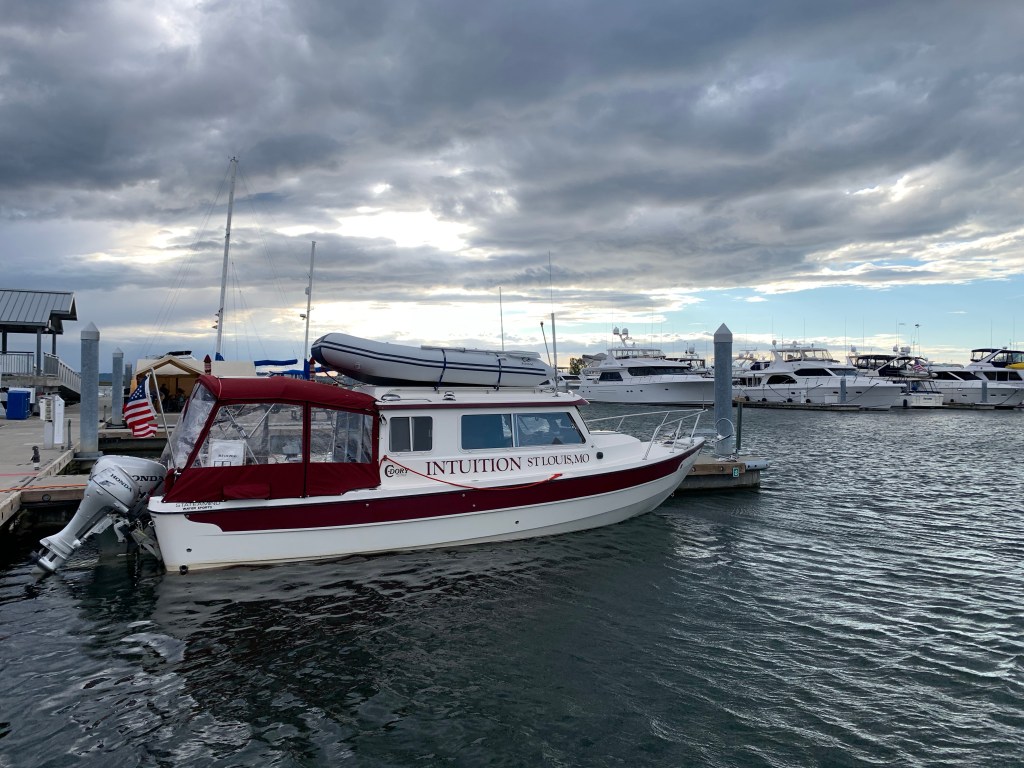
Approaching the Cap Sante marina
Docked at Roche Harbor Resort (San Juan Island)

Steep your life in God-reality, God-initiative, God-provisions. Don’t worry about missing out. You’ll find all your everyday human concerns will be met. (Matthew 6:33 The Message)

Trailering (Intuition Diaries)

Outfitted and ready for the water trek to southeast Alaska to explore the Inside Passage

Welcome to Intuition Diaries, where Les and I tell you about our adventures on our happy little boat. We’re heading to Alaska this time!!!

One of the factors in choosing our little boat (a 25ft C-Dory) was that it could be trailered to most any body of water. Its compact size houses the helm, sleeping area, eating area and galley plus a bathroom inside the cabin. So not only could we take it places, we could “camp” on it while exploring different locations. We’ve had Intuition for about 11 years now, and one of the biggest trips we’ve dreamt about was this one: to trailer the boat to Alaska and explore the Inside Passage.

After towing our boat halfway across the country, we’re ready to embark on this adventure. We finished outfitting the boat with our new inflatable dinghy, recently bought groceries and topped off our water supply. We already gassed up the boat, while still on the trailer, at a gas station called Twin Peaks. (They had good coffee there, but I forgot to try their donuts.)

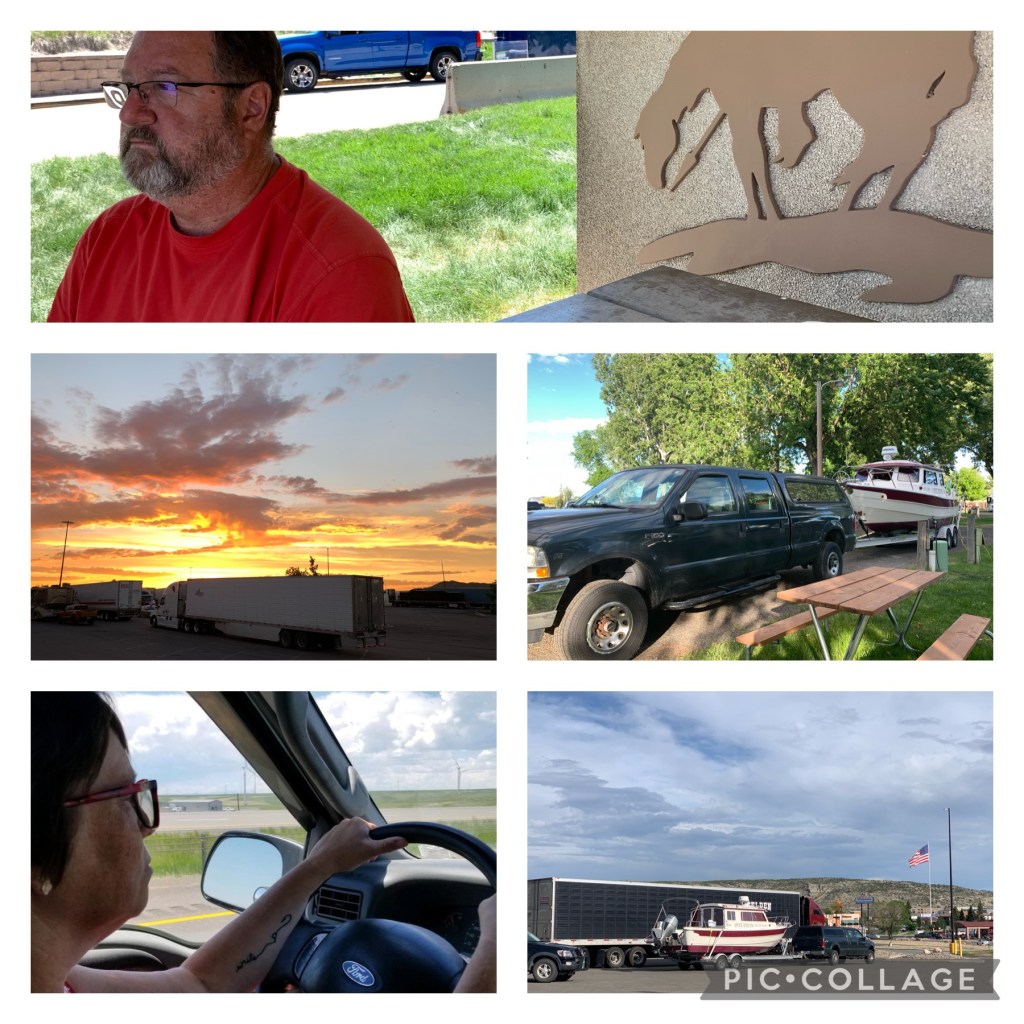
Over the past four days, we traveled from St. Louis covering 2150 miles, including sections of eight states. Les did the majority of the driving, and I learned to appreciate the immensity of towing a 7000 pound boat and trailer behind our truck. (I’ve never driven with the trailer and boat hooked up to the truck before, so when I drove 79 miles straight without incident, I was pleased with my effort and Les guiding me in the finer points.) The section I drove was fairly flat and desolate. Les managed the mountainous climbs and descents with apparent ease, and I was glad to let him.

This trip will be more challenging than previous ones. The first challenge was the long distance of getting the boat here, which thankfully included sunny days and no mechanical mishaps. The second challenge will be traversing 750 miles of waterways to get to Ketchikan, Alaska. To make this work, we need to pace ourselves, and stay alert to the weather, tides, protocols of entering Canadian waters, and then navigating and enjoying the waterways of the Inside Passage in southeast Alaska.

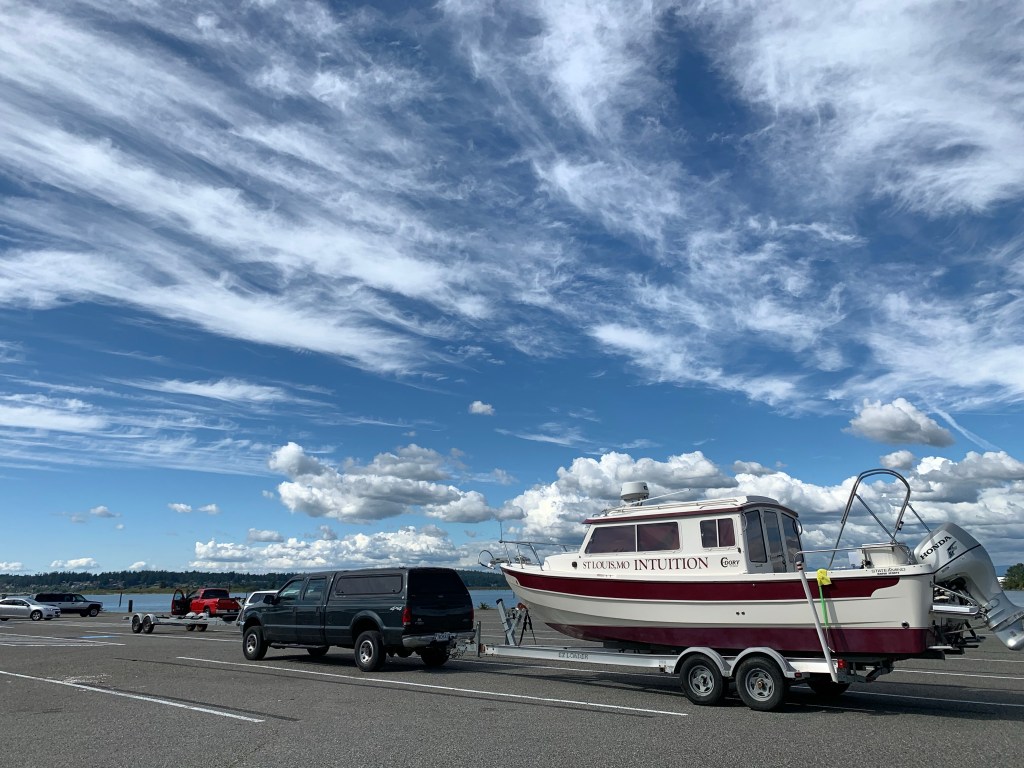
On the way here, I noticed that we stopped more often than in the past. Les told me that we could stop at as many of the rest stops along the way as we wanted, plus we stopped twice a day to fill the truck with gas. Sometimes a meal coincided with the gas stop, or we made a picnic lunch at one of the highway rest areas. Getting off and on the highway is the most stressful because we have no idea which gas station will fit our rig or if there’s enough room to park at a McDonald’s. (We don’t do drive-thru with our 54 foot rig.) On average we paused about 6-7 seven times a day, often clocking 14-hour days including travel and stops. Each night we camped on the boat aloft the trailer. We stayed in Walmart parking lots and one campground under the mountains of Baker City, Oregon. At the end of the fourth day, we navigated around the Port of Everett marina to get to the ramp, where we put the boat in the water of Puget Sound.

On the road trip portion, I noticed that each rest stop had its own character. In Nebraska, the green space and sculptures gave us a beautiful place to stretch our legs. In Oregon, the rest stops provided corrals to exercise your horses. In Washington, we stopped at Selah Creek, where we were warned to watch out for rattlesnakes. It reminded me that rest is necessary, especially when dangers abound. I noticed little things like a bear face on the door lock, the welcoming roses and volunteers at the Oregon info center. I couldn’t stop oohing over the beautiful land forms along our route. If I am this mesmerized by nature and signs and rest areas, how will I be able to embrace all the celebrated majesty of Alaska? My answer: Pace myself. Stop and smell those roses. Admire the fountain wash basin. Read the signs. Walk around and take photos of everything. Notice flowers, birds and little ground squirrels, who act like they might climb right up your leg.

Each leg of this trip will have its own character. The preparations seasoned us for decisions we will have to make in the days ahead. We’ve learned to pause and listen, to ask clarifying questions, and make suggestions as needed. And I’ve learned to walk away when I feel frustrated or say I need a break for a bit.

Today was a “rest” day, but it was constructive rest. We rested from the road. We walked around the marina to get showers and do laundry. We drove into town for a last few minute items. Les successfully took the truck to the storage place, and I washed up dishes. The days ahead hold a lot of promise, and one thing for sure is that we will relax and enjoy as much as possible, while being realistic about the challenges.

Parking lot at Port of Everett marina, our beginning point

If you’d like to see more photos from the trip, check out Kel’s Facebook page. She also posts some pics on Instagram…kelrohlf

I said to myself, “Relax and rest. God has showered you with blessings. (Psalm 116:7 The Message)

Bittersweet Beginning (Intuition Diaries)

Knot inside anchor locker that secures the rope and chain attached to our anchor

In ten days, my husband and I plan to be riding in our truck towing our boat, Intuition, towards our dream adventure: exploring the Inside Passage of Southeast Alaska. Over the past ten years or so, since we got the boat, we’ve talked about that one day when we would go to Alaska. Each trip on the boat has prepared us for this upcoming expedition. It’s more than a weekend on the river, but those trips have taught us that the preparations are the same for a couple days or a couple weeks. This time we will be away for several weeks. We are natural planners and problem solvers, so this trek together might seem like a breeze, but we still encounter frustrations and disappointments, as would be expected. Somehow though I get caught off guard. I believe these two states of being should be farther and fewer between as I gain more life experience, yet it is not so.

We have been planning, preparing, and outfitting the boat with things that will make the trip easier. We celebrated this week restoring the anchor to our boat. Last year, we said good-bye to our faithful anchor at the bottom of Mark Twain Lake. It was quite upsetting, as I like to applaud myself for avoiding the typical boating mishaps like mold in the cabin and engine failures and cutting the anchor loose because it held too well. So when Les asked me to load the new rope/chain (also called the rode) which was attached to the new anchor into the windlass (the new electric winch), I felt honored. The rope was in a big heap. It needed to be untangled and laid out for ease in feeding it into the windlass. Also there was a knot that needed to be undone, which meant taking the end without the anchor (300 feet or so of rope) and threading it out of the knot. He nonchalantly told me I had to start at the bitter end.

Yes, that is what the end without the anchor is called. I haven’t done any research, but I immediately understood because of the bitter ending of our last anchor. If you have to cut loose the anchor, then all you have left is the rope. It was a bittersweet moment when I lowered the last of the chain into the anchor locker. Our new shiny anchor sat in the spot where our faithful one used to be.

Enough about the anchor. Let’s talk about dinghies. A dinghy is a small boat that resides on a big boat, in order to get ashore or to explore shallower waters. We often use our two-person kayak for that purpose, and also own an inflatable one that we’ve used a couple times over the past several years. One notable time was on a very rainy beginning of a trip, and we were using a hand pump to inflate it. We got soaked, but the dinghy didn’t mind. On a trip like this one to Alaska, our inflatable dinghy is more of a necessity to get ashore and to see glaciers up close, but not too close mind you.

On Monday, as the part of the process, we took our newly outfitted boat to the river. It was time for the trial run. We packed most of our stuff, as if we were going to Alaska. We wanted to try out the dinghy with its new electric motor. I was stowing things inside and setting up the bimini on the back, while Les took the hand pump to inflate the dinghy. I came down to share the task; it was slow going. It was about halfway inflated when the pump failed. We didn’t have the time or the cool breezes or patience to replace the pump (we’d need to order it probably anyways.) As Les was deciding to just put it away, even though we were frustrated and disappointed, I was determined to solve the problem.

I started asking Les questions about vacuums and tape and hoses. He gave me the space to try out my idea. I said if it worked, he had to take a picture. I attached the input hose with silicon tape to the vacuum hose. I used the output of the vacuum to inflate the dinghy. It worked! I was elated! Les snapped a picture, and we moved on to other tasks.

Several minutes later, we went to get the dinghy to haul it onto the roof of the boat. The air had seeped out. Our mood deflated. We tried not to cry or yell or swear, I can’t remember if we were successful. Apparently a section of the seam had come unglued over the years. In the end, we packed it back into the truck, and continued with our plan to test out other systems on the boat, while out on the river. We hoped to relax a little, too.

Tuesday morning, we compared notes on the list of things that needed tweaking, and each time we found something it was kind of discouraging, but at the same time we needed to know these things before we go to Alaska. We decided the best measure was to replace our old dinghy with a new one. (The old one could be repaired, but not in time to leave on schedule.) The other fixes we could make after relaxing one more night on the boat. We decided to head to Hardin, Illinois to eat dinner at Mel’s and anchor out behind Mortland Island.

After pulling up the anchor, near Portage Island, using the windlass, which by the way worked without any frustration, I noticed a puddle of water in the walkway of the cabin. Change of plans again! Instead of dinner at Mel’s, We headed towards the ramp to take out the boat. We needed to trouble shoot the water problem. With some more frustration, we managed to get the boat on the trailer.

Today, thankfully, were able to bring the boat home, so we can work on it here, rather than out at the storage lot. (We haven’t been able to get it home because of road work in our neighborhood.) Boating is very fun, but also a lot of work. This bittersweet beginning will not be the end of our adventuring. We’ve come to understand that part of the joy is overcoming the setbacks and other obstacles. The trial run was also training for the challenges ahead. We’re learning that the bitter comes with the sweet; beginnings and endings are new each day.


I remember it all—oh, how well I remember—
    the feeling of hitting the bottom.
But there’s one other thing I remember,
    and remembering, I keep a grip on hope:

God’s loyal love couldn’t have run out,
    his merciful love couldn’t have dried up.
They’re created new every morning.
    How great your faithfulness!
I’m sticking with God (I say it over and over).

Lamentations 3:20-24 (The Message)