Delight: Extreme Satisfaction; Joy

Keep company with God,
    get in on the best.
(Psalm 37:4 The Message)
 
Take delight in the Lord,
    and he will give you your heart’s desires.
(Psalm 37:4 NLT)


Last month filled my heart with great satisfaction. I kept company with God with my nieces and nephews. We had quiet, creative mornings and fun-filled afternoons. We met with friends and we stayed home.
 
My favorite memory of the month was introducing them to the idea of meeting with Jesus in their heart room. My sister gave us a book of meditations to read over the month. Most mornings after breakfast, we gathered in the quiet corner and contemplated some object that introduced us to an aspect of God’s love and presence in our lives.
 
We imagined a kite flying freely in the sky, and then we thought about how God holds us secure, yet allows us to express ourselves freely. How the presence of the Holy Spirit sustains us and thrills us as we soar in God’s loving care.
 
One day we recalled the birth of Jesus. Then we contemplated the cross and the pain He suffered on our behalf. The next day we celebrated His triumph over death. We remembered His sacrifice with the bread and with the cup.
 
Our days together ended with a loss. During our last week together, our dear dog, age fourteen, became feebler. Each child responded in their own way, when we told them she had died. We cried and talked about her life, and my youngest niece led us in a meaningful memorial time by burying Milli’s collar and play toy in the garden.
 
What delight children and pets bring to our lives. I am grateful for the time we had together, both the highs and lows of the month. As we go into July, I have prayer on my heart.
 
Sometimes I find it difficult to pray. At those times I am drawn to the written prayers of others. Last week, also marked the death of a dear family friend. She lived far from us, and I am thankful for the years we were able to visit with her the past several summers. Over the years my family and I enjoyed Mary’s company and her hospitality, whenever we came in to town for a visit.
 
Here is a prayer for those who love her and miss her:
 
Almighty God, Father of all mercies and giver of all comfort, deal graciously we pray as we mourn, casting all our care on Thee, knowing the consolation of Thy love; through Christ Jesus Our Lord.
 
(Book of Common Prayer 1928, adapted)

Thrilling Guest Thursday: Lynn D. Morrissey


O death, where is thy sting? O grave, where is thy victory?
(1 Corinthians 15:55 KJV)

What greater tribute can a child give their parent than heartfelt words penned to celebrate the parent’s life and mourn his absence. Lynn, in her eloquent voice, does just this as she remembers her daddy.

<!–[if supportFields]> SEQ CHAPTER \h \r 1<![endif]–><!–[if supportFields]><![endif]–>Nearly six years ago, while my beloved father relinquished his mortal coil, God released his soul like a shooting star, arc-ing right through the galaxies straight to His heart. After a six-month odyssey of agony, a living death, Daddy was blessedly transformed—that quickly, that effortlessly, that mysteriously—in a breathtaking nanosecond, in the twinkling of an eye. Absent from the body, present with the Lord—absent from withering flesh to wondering felicity, from careworn burdens to contented bliss, from dark-glass knowing to face-to-face intimacy with the God he loved.
                                                           
Oh, without question, I was relieved that my father no longer suffered. After a treacherous fall that broke his neck, mercifully sans paralysis, my father lay tethered to a hospital bed by a tangle of tubes and needles, a plethora of pain and indignity. He suffered more than anyone I’ve ever known. And in ways impossible to convey, we suffered with him. We agonized over all he endured.
So how could I have possibly wanted that to continue? No, I was relieved that his suffering was over.
And yet, to let him go was excruciating. How could I let go the man I’d loved my whole life, my larger-than-life hero? How could I let go his bear-hug embrace, his mammoth hands that encompassed mine or playfully crushed the hands of my would-be suitors, his beautiful basso-profundo voice, his hardy laughter, impish humor and twinkling ice-blue eyes, his constant, but good-natured prodding: “Lynn, what are you writing today?”
People offered sincere comfort: “He’s no longer suffering. He’s in a better place. He’s with the Lord.” Yes, I knew that, and yes, I was comforted, but Daddy wasn’t with me, and I grieved his loss, his tangible, physical presence, his warmth, his strength. Someone encouraged, “But you’ll be with him soon.” I knew he meant well, but soon? If I lived a normal life span, I would live without my father for at least another twenty years.
Death had torn my father away, and it was tearing me apart. Death was never meant to be, and this ripping of body from soul was unnatural. It was not what God had originally intended. So despite that I could rejoice that my father was in heaven, I still longed for him here on earth. I missed him body and soul, missed all of him, all that he was.
Ten days after Daddy died, I attended a journaling retreat, where, ironically, I couldn’t journal about him. God had always used journaling as a means of deep catharsis in my life, but after grieving in writing for six months during my father’s prolonged hospitalization, I had nothing left to say. Looking back, I realize that God was protecting me. My grief was so cavernous, that had I spilled my soul into a blank journal, I would never have been able to stop writing. I would have plummeted into a grief gorge, unable to grope my way out.
But God knew that I still needed a way to release my pain. One day, without conscious thought, I started to scratch words on a tablet—words that I hadn’t intended to write, words about my father’s physical being, the actual man I missed so much. Without initially realizing it, I was writing a poem, a much smaller container to house my grief, a far more manageable vessel for holding despair. God used this amazingly simple form of writing as an important first step in a monumental healing process.
To Christians reading this post, I remind you that I know my father’s soul is absent from the grave. His true essence is with the Lord. And yet, God made us body and soul, and when we grieve it’s important not to disregard our incalculable loss of an actual, physical person. This is the sentiment I tried to convey in “The Box.”
Oh how I long for the day when God will reunite Daddy’s body and soul in the reality of resurrection. God promises that my father will live whole in His presence, in the new heaven and the new earth. And I long for that day, when I will join my Father and my father, never to be separated.
If you are experiencing a grief too deep to bear, despair that threatens to overwhelm, might you pick up your pen and write some small, one-line descriptions and remembrances of the person you loved so well? Write a short poem or psalm of lament. Let your pen lance your wound. Let your words heal your heart.



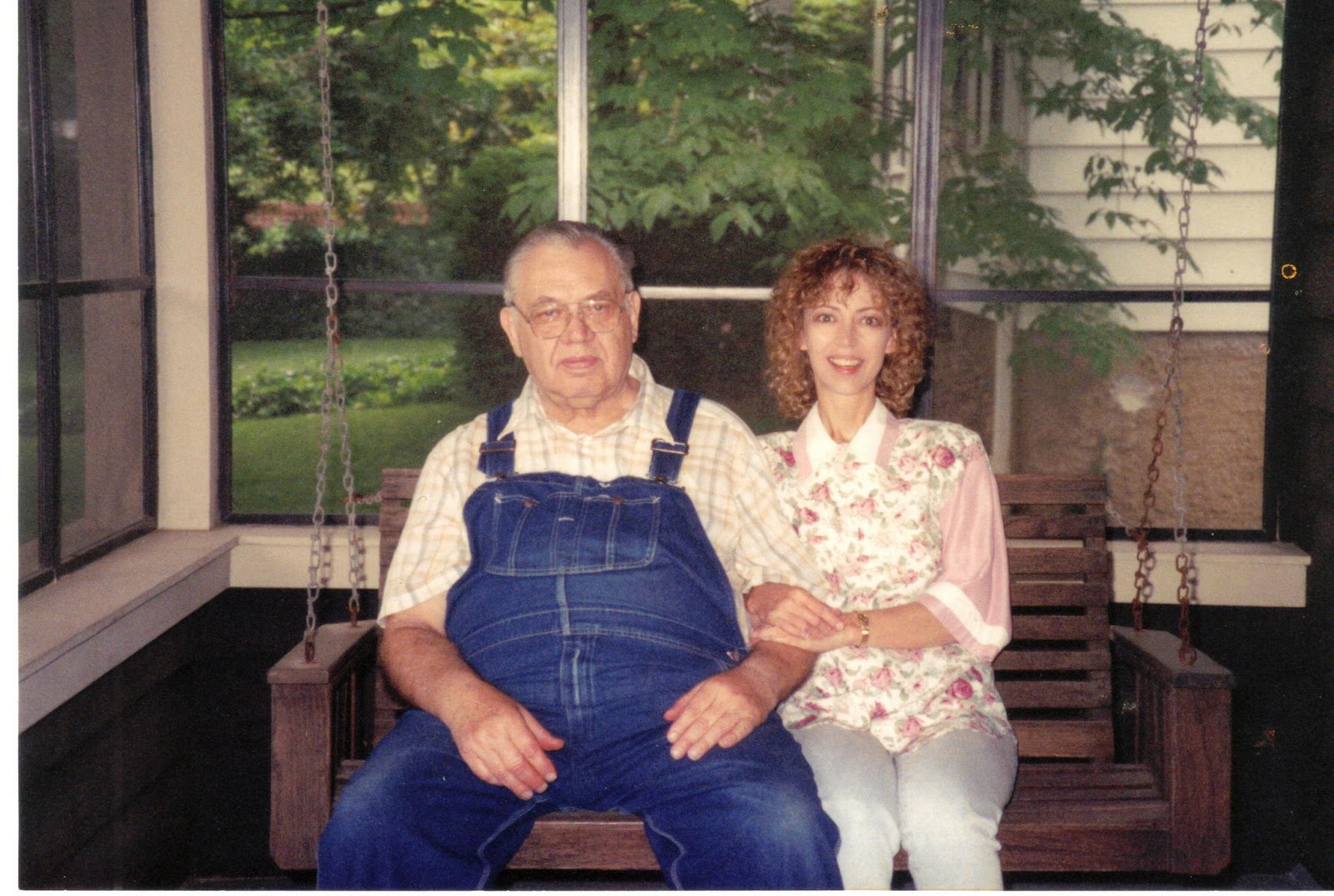
Lynn with her father, Bill Morrissey


The Box
For Daddy
Your favorite plaid shirt—well-worn, softened squares of red and blue—
was torn clean through at mid-sleeve,
and frayed—terribly frayed—where your angular elbows, roughened,
yet softened with time, thrust through.
Your dark denim overalls, homey, capacious,
deliciously splattered with rays of white paint,
like a midnight sky spattered with sprays of bright stars,
were your second skin.
Your big, black shoes (size thirteen)—you called them boats!—
anchored your once-six-foot frame to earth,
as you lumbered cumbersomely along,
your cold-steel cane flanking you, too.
You were no fashion plate.
But you had a beautiful box:
polished mahogany, smooth as silk,
filled with milk-white clouds and satin puffs,
stuffed like an elegant jewel case and adorned
with bright-brass Pieta replicas and shining panels of Lord’s-Supper reliefs.
I ran my hand along its handles, along its glistening, beveled edges,
reverently reveling in its richness,
gripping its resplendence.
And now, in grief,
in throat-stripping weeping,
we must grip ourselves.
We place our priceless treasure in the box,
carefully, oh so carefully.
We fluff the clouds, smooth the satin folds,
arrange your body like one arranges fragile flowers,
then close the lid.
And we lock it tight against the night.
We lock it hard for holding,
secure for safe, safe keeping.  


2013 Copyright. All Rights Reserved. Lynn D. Morrissey


Lynn D. Morrissey, is a Certified Journal Facilitator (CJF), founder of Heartsight Journaling, a ministry for reflective journal-writing, author of Love Letters to God: Deeper Intimacy through Written Prayer and other books, contributor to numerous bestsellers, an AWSA and CLASS speaker, and professional soloist. She and her beloved husband, Michael, have been married since 1975 and have a college-age daughter, Sheridan. They live in St. Louis, Missouri.

You may contact Lynn at words@brick.net.

Please feel free leave your comments for Lynn on this post.

Revisiting the Dream Retreat

In the resurrection scheme of things, this has to happen: everything perishable taken off the shelves and replaced by the imperishable, this mortal replaced by the immortal. Then the saying will come true:

 
Death swallowed by triumphant Life!
Who got the last word, oh, Death?
Oh, Death, who’s afraid of you now?
 
It was sin that made death so frightening and law-code guilt that gave sin its leverage, its destructive power. But now in a single victorious stroke of Life, all three—sin, guilt, death—are gone, the gift of our Master, Jesus Christ. Thank God!


With all this going for us, my dear, dear friends, stand your ground. And don’t hold back. Throw yourselves into the work [the dream] of the Master, confident that nothing you do for him is a waste of time or effort.  (1 Corinthians 15:53-58  The Message)


As I strolled through the historic Key West cemetery, I was looking for some metaphor of life overcoming death. Mostly I saw rusted gates and concrete angels. Row upon row of family plots and cement boxes stacked on top of each other memoralizing lives now gone. Some were topped with crosses and others with plastic beads and silk flowers.
 
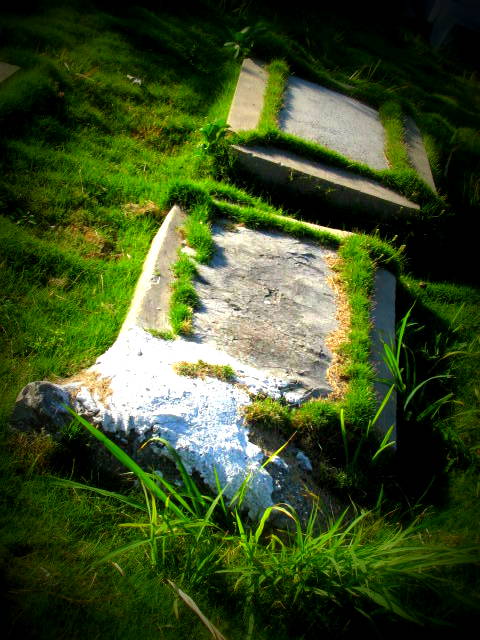
Then I came upon this plot, where the cement beds looked quite worn, the names of the deceased long eroded. Yet grass was growing up through the cracks. How can life flourish in the midst of death? That is the miracle of resurrection and Easter.
 
And that is the mystery of dreams.
 
Just about the time you believe your dream has died and been long buried, growth appears. An idea pushes up through the cracks.
 
I checked the church calendar today. It’s the sixth week of Easter. Most of the candy is gone, the palm branch is drying out and the fancy clothes have been pushed to the back of the closet, but the pulsing life of Jesus still runs through my soul. It calls me to live and to dream big. To embrace the resurrection power. To claim a mind that is not daunted by fear, but filled with Spirit strength and love and sound thinking.
The dreamer’s retreat has faded to the back of my mind, but I still pull out the notes I scribbled in my notebook, looking for those words that moved me and affirmed that I should keep moving ahead.
 

I appreciated how Holley Gerth  invited us to explore practical, tangible ways to handle our dreams: Write your dream on a card. Draw three intersecting circles and list your skills, your strengths and those people you want to serve. What connections do you discover?

I rediscovered that I am an encourager who loves to use words and creativity to draw out the beauty of our God-created identities, so together we can live generously and graciously toward one another, like God lives towards us. (See Matthew 5:48b The Message)

 
And that’s the point. Holley said it well, “God is the point of the God-sized dream.”


Thrilling Guest Thursday: Lynn Morrissey

 
You’re blessed when you feel you’ve lost what is most dear to you. Only then can you be embraced by the One most dear to you. (Matthew 5:4 The Message)


Death springs forth often unexpectedly, yet through Christ, death has lost it’s sting. Today, I have invited Lynn D. Morrissey to share how she uses writing poetry as a means to honor a loved one who has passed on from this life.  As I comtemplated her poem, I not only thought of grieving over a person, but also sorrowing over any loss, including seasons of life. Lynn opens with an introduction to her writing process and then we have her poem.  (Kel)

Here’s Lynn:

When loved ones die, we long to remember—to remember the sheen of her hair and the shine of her eyes, the sway of his gait and the sound of his voice, the lilt of their laughter and the lyrics of their heart.

We think we’ll never forget, but we do. Cherished memories recede like haunting echoes of a faraway loon, like sepia photographs fading with time …

We need a way to remember—to indelibly stamp our beloved’s heart-print onto our own so that we might never forget. And one sure way is with ink, in words. Writing traces whorls and swirls of our soul into patterns of permanence. Writing remembers. Writing honors. Memories penned say, You lived and loved. You laughed and lamented. You mingled and mattered. Scribed remembrances bottle the fragrance, the feelings, the fellowship of relationships that once were, and now always can remain, stored in the heart.

I penned this poem in memory of a friend’s mother upon the first anniversary of her passing. I offered it to him, with love, as a way to say, I honor her, and in so doing, I honor you. Roses were her favorite flower. Surely, their summer fragrance evokes for my friend his mother’s memory now, even in the winter of his grief. Hopefully, too, my words etch her essence, making her soul visible, and remind him of the presence and purposes of the invisible God in life and in death.

                                                                        
Might you consider composing a “roses of remembrance” poem honoring someone you miss or as a gift for someone who has lost a loved one? One form of poetry which is especially meaningful is an alpha poem (abecedarian), which uses a person’s name in bold lettering as a vertical acrostic around which to wrap the body of the poem. I have done this numerous times, and had the poems framed as a special gift. They are always received with emotion and gratitude. You could do the same and offer special comfort to those who need it.

Roses of Remembrance

 
“God gave us memory so that we might have roses in December.” —Barrie


A year has come and gone,

commemorated with parading autumnal suns
(and those of winter, spring, and summer),
marking the march of unstoppable days.

The spray of crimson roses, long-since frayed atop her stone,

has fleetly decayed like a tatterdemalion scattering of tears, petaling her grave—
vanished, unsettingly, sans trace.

Why must roses languish and die?

Why must their grace, their velvetine voluptuousness
corrupt,
giving sway to decline,
as day gives way to night,
laughter to tears,
melismas to silence?
Why must that which can but delight
take flight like a sudden exultation of larks
beating rapturous wings into darkness,
then disappear?

Why can’t roses endure in Edenic purity—

vivid, redolent, regal in unequaled beauty?
Why must evanescence quell such magnificent efflorescence?

Why?

There is no answer but to question, How?


How to live in light of all deaths, little and large,

in light of what we cannot fully comprehend,
but have no choice but to accept?
How to face all endings, their unequivocal inevitability?
How to grasp what eludes, preserve what won’t last?
What’s our charge?

To live largely, lavishly,

cultivating God’s flowers
and souls and hours and minutes minutely,
with open eyes and open arms,
relishing each one,
distilling them to their core,
and when they’re no more . . .
gathering roses of remembrance
—fragrant with love, past; perfuming life, present—
emblems of what never dies: the rose’s essence.

God prunes the bush with death’s sharp shears,

so that there might inevitably be a heavenly, beatific blossoming,
so that Eden might flourish anew,
eternally …

(Copyright 2013. All Rights Reserved. Lynn D. Morrissey)

Lynn D. Morrissey, is a Certified Journal Facilitator (CJF), founder of Heartsight Journaling, a ministry for reflective journal-writing, author of Love Letters to God: Deeper Intimacy through Written Prayer and other books, contributor to numerous bestsellers, an AWSA and CLASS speaker, and professional soloist. She and her beloved husband, Michael, have been married since 1975 and have a college-age daughter, Sheridan. They live in St. Louis, Missouri.
You may contact Lynn at words@brick.net.
Please feel free to comment to Lynn on this post, as she will be checking comments. We appreciate feedback and your responses to her work.

Lessons from the Butterfly

And we all, who with unveiled faces contemplate the Lord’s glory, are being transformed into his image with ever-increasing glory, which comes from the Lord, who is the Spirit.
(2 Corinthians 3:18 NIV)


” . . . I noticed a chrysalis collection in a case on the wall. Though all different in size and shape, they shared one thing: Each was a tomb of transformation, a womb of waiting where the caterpillar must die, in a sense, in order to be born a butterfly.”
(Lynn Morrissey,  Love Letters to God:
Deeper Intimacy Through Written Prayer)


Last Friday, I tried to capture the glory of the Blue Morpho butterflies swarming around the tropical setting of the Butterfly House. They were just too swift for me to snap a picture of them in flight. I had to be content with experiencing their beauty standing still in the moment. 
 
The beauty of a butterfly is fleeting. Did you know the Blue Morpho butterfly only lives for three weeks after it breaks out of its chrysalis? Some may think this is a gross waste of such beauty, yet God in His wisdom and grace grants us this brief glimpse of His glory.
 
Here’s another fascinating fact about butterflies: The delicate butterfly inherits the honor of laying the eggs to reproduce this species, not the caterpillar. 
 
What a picture of spiritual growth! What would happen if we didn’t progress past the egg, the caterpillar and the chrysalis stages? Our spiritual growth would not only be stunted, it would be aborted. To become the most beautiful reflection of the glorious One, one must die to self.
 
It is imperative to mature into a spiritual butterfly, or we will not multiply. We will not see others birthed into the kingdom of God.