Post: To Make Familiar With a Subject


I pour out my complaint before Him;
I declare before Him my trouble.
(Psalm142:2 NKJV)

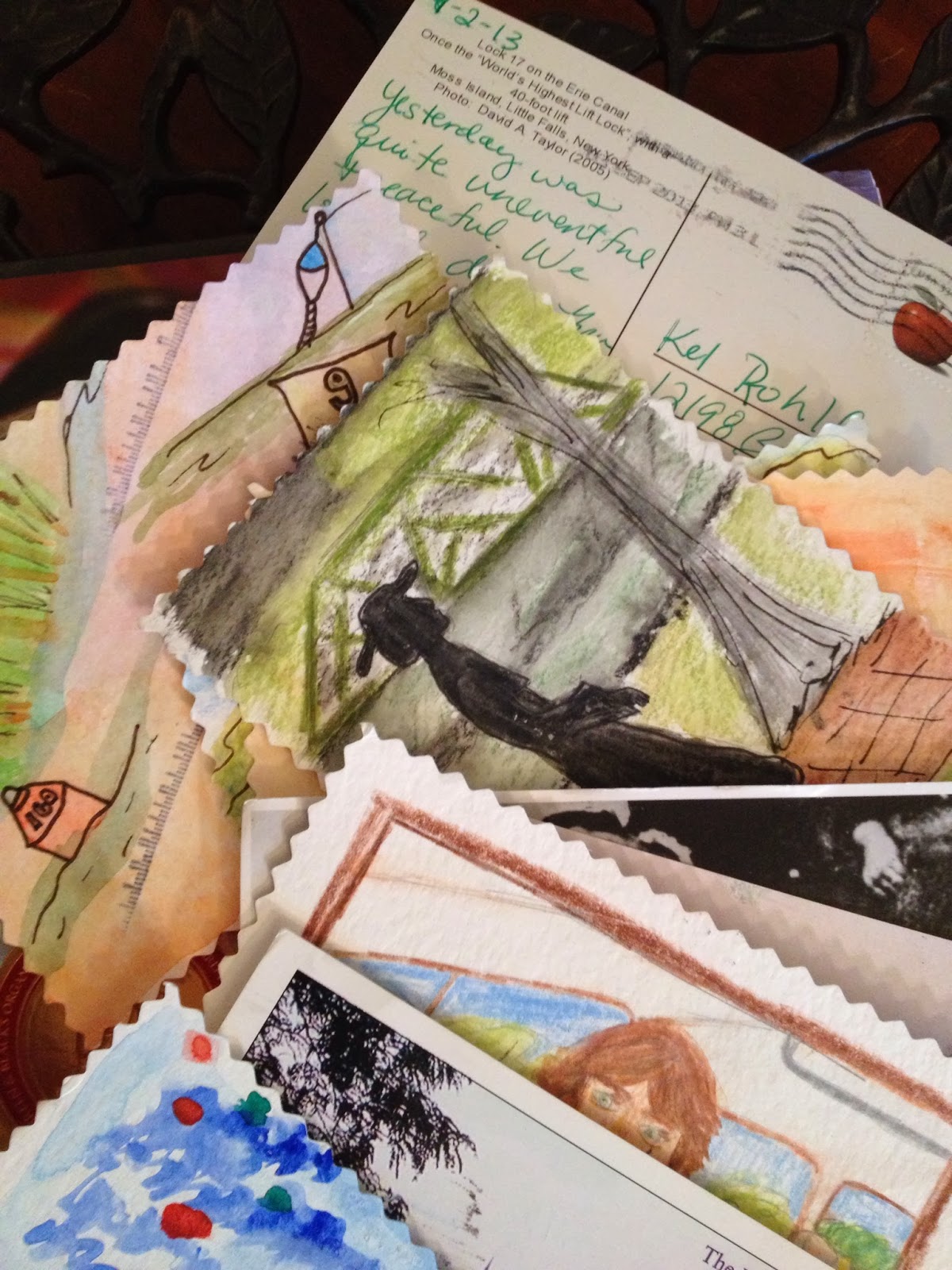
I sent these postcards to myself, as a type of diary
chronicling our trip on the Erie Canal.
Do you ever wish you could send a letter to God, addressed to His complaint department? What if you could send Him a thank you note? Or a postcard telling Him how much you love Him? 

Let’s get out the stationery. For this quiet time activity, I prefer the touch of pen to paper, but if you are tech savvy, adapt this idea with e-mail or a scheduled reminder text.


In 30 Ways to Wake Up Your Quiet Time, Pam shares her thoughts on the topic of writing a letter to God:

Write a letter to God about your life. What would you like to see happen in the next three to six months? What would you like to learn about God? What requests would you like answered? Maybe you are at a special juncture  in life, have an obstacle to hurdle or circumstance you’d like to see change. Write out your feelings, goals and requests.

Place your letter in a self-addressed stamped envelope. Give the letter to a friend to mail back to you after three, six or twelve months. [Or send it to yourself, with an “open on” date written on the envelope.]

I found this idea helpful after the death of my father. I took a limited sabbatical…but after two months I still wasn’t feeling emotionally better. I wrote a letter to God about how I wanted to feel at the one-year anniversary of my father’s death. As I wrote the letter, I realized I was not going to be able to make this journey alone. I wrote down books to read. I contacted a grief counselor. I wrote out activities that I though would help me resolve my feelings and bring closure…ten months into the journey…I am much further along in my grief than I would have been if I had not take this quiet time with God to verbalize how I need him to heal me. 

There are some journeys we don’t want to go on, but writing to God about the difficult path ahead makes the road less formidable.

©Pam Farrel from 30 Ways to Wake Up Your Quiet Time (IVP). For more devotional books by Pam http://www.Love-wise.com


What kind of letter do you need to write to God? Is there a subject you need to share with Him in prayer?


To read all the posts in 31 Days of Quiet click here.

Thrilling Guest Thursday: Lynn D. Morrissey


O death, where is thy sting? O grave, where is thy victory?
(1 Corinthians 15:55 KJV)

What greater tribute can a child give their parent than heartfelt words penned to celebrate the parent’s life and mourn his absence. Lynn, in her eloquent voice, does just this as she remembers her daddy.

<!–[if supportFields]> SEQ CHAPTER \h \r 1<![endif]–><!–[if supportFields]><![endif]–>Nearly six years ago, while my beloved father relinquished his mortal coil, God released his soul like a shooting star, arc-ing right through the galaxies straight to His heart. After a six-month odyssey of agony, a living death, Daddy was blessedly transformed—that quickly, that effortlessly, that mysteriously—in a breathtaking nanosecond, in the twinkling of an eye. Absent from the body, present with the Lord—absent from withering flesh to wondering felicity, from careworn burdens to contented bliss, from dark-glass knowing to face-to-face intimacy with the God he loved.
                                                           
Oh, without question, I was relieved that my father no longer suffered. After a treacherous fall that broke his neck, mercifully sans paralysis, my father lay tethered to a hospital bed by a tangle of tubes and needles, a plethora of pain and indignity. He suffered more than anyone I’ve ever known. And in ways impossible to convey, we suffered with him. We agonized over all he endured.
So how could I have possibly wanted that to continue? No, I was relieved that his suffering was over.
And yet, to let him go was excruciating. How could I let go the man I’d loved my whole life, my larger-than-life hero? How could I let go his bear-hug embrace, his mammoth hands that encompassed mine or playfully crushed the hands of my would-be suitors, his beautiful basso-profundo voice, his hardy laughter, impish humor and twinkling ice-blue eyes, his constant, but good-natured prodding: “Lynn, what are you writing today?”
People offered sincere comfort: “He’s no longer suffering. He’s in a better place. He’s with the Lord.” Yes, I knew that, and yes, I was comforted, but Daddy wasn’t with me, and I grieved his loss, his tangible, physical presence, his warmth, his strength. Someone encouraged, “But you’ll be with him soon.” I knew he meant well, but soon? If I lived a normal life span, I would live without my father for at least another twenty years.
Death had torn my father away, and it was tearing me apart. Death was never meant to be, and this ripping of body from soul was unnatural. It was not what God had originally intended. So despite that I could rejoice that my father was in heaven, I still longed for him here on earth. I missed him body and soul, missed all of him, all that he was.
Ten days after Daddy died, I attended a journaling retreat, where, ironically, I couldn’t journal about him. God had always used journaling as a means of deep catharsis in my life, but after grieving in writing for six months during my father’s prolonged hospitalization, I had nothing left to say. Looking back, I realize that God was protecting me. My grief was so cavernous, that had I spilled my soul into a blank journal, I would never have been able to stop writing. I would have plummeted into a grief gorge, unable to grope my way out.
But God knew that I still needed a way to release my pain. One day, without conscious thought, I started to scratch words on a tablet—words that I hadn’t intended to write, words about my father’s physical being, the actual man I missed so much. Without initially realizing it, I was writing a poem, a much smaller container to house my grief, a far more manageable vessel for holding despair. God used this amazingly simple form of writing as an important first step in a monumental healing process.
To Christians reading this post, I remind you that I know my father’s soul is absent from the grave. His true essence is with the Lord. And yet, God made us body and soul, and when we grieve it’s important not to disregard our incalculable loss of an actual, physical person. This is the sentiment I tried to convey in “The Box.”
Oh how I long for the day when God will reunite Daddy’s body and soul in the reality of resurrection. God promises that my father will live whole in His presence, in the new heaven and the new earth. And I long for that day, when I will join my Father and my father, never to be separated.
If you are experiencing a grief too deep to bear, despair that threatens to overwhelm, might you pick up your pen and write some small, one-line descriptions and remembrances of the person you loved so well? Write a short poem or psalm of lament. Let your pen lance your wound. Let your words heal your heart.


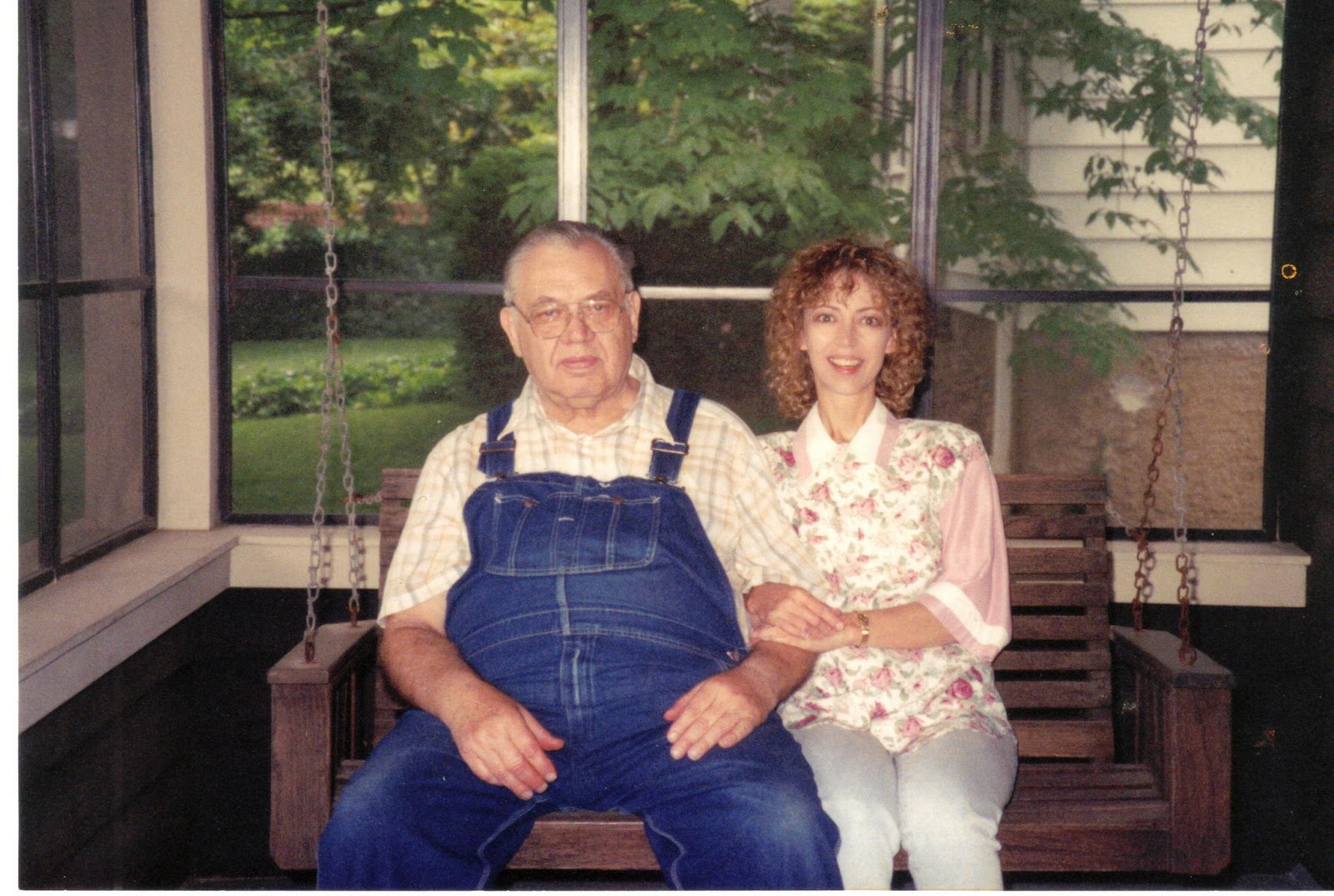
Lynn with her father, Bill Morrissey


The Box
For Daddy
Your favorite plaid shirt—well-worn, softened squares of red and blue—
was torn clean through at mid-sleeve,
and frayed—terribly frayed—where your angular elbows, roughened,
yet softened with time, thrust through.
Your dark denim overalls, homey, capacious,
deliciously splattered with rays of white paint,
like a midnight sky spattered with sprays of bright stars,
were your second skin.
Your big, black shoes (size thirteen)—you called them boats!—
anchored your once-six-foot frame to earth,
as you lumbered cumbersomely along,
your cold-steel cane flanking you, too.
You were no fashion plate.
But you had a beautiful box:
polished mahogany, smooth as silk,
filled with milk-white clouds and satin puffs,
stuffed like an elegant jewel case and adorned
with bright-brass Pieta replicas and shining panels of Lord’s-Supper reliefs.
I ran my hand along its handles, along its glistening, beveled edges,
reverently reveling in its richness,
gripping its resplendence.
And now, in grief,
in throat-stripping weeping,
we must grip ourselves.
We place our priceless treasure in the box,
carefully, oh so carefully.
We fluff the clouds, smooth the satin folds,
arrange your body like one arranges fragile flowers,
then close the lid.
And we lock it tight against the night.
We lock it hard for holding,
secure for safe, safe keeping.  


2013 Copyright. All Rights Reserved. Lynn D. Morrissey


Lynn D. Morrissey, is a Certified Journal Facilitator (CJF), founder of Heartsight Journaling, a ministry for reflective journal-writing, author of Love Letters to God: Deeper Intimacy through Written Prayer and other books, contributor to numerous bestsellers, an AWSA and CLASS speaker, and professional soloist. She and her beloved husband, Michael, have been married since 1975 and have a college-age daughter, Sheridan. They live in St. Louis, Missouri.

You may contact Lynn at words@brick.net.

Please feel free leave your comments for Lynn on this post.
At Rest: Free from Anxieties


The Spirit immediately drove him out into the wilderness. And he was in the wilderness forty days, being tempted by Satan. And he was with the wild animals, and the angels were ministering to him.
(Mark 1:12-13 ESV)
 
 
As I enter the fifth week of Lent, I wonder how Jesus felt as He endured the last weeks of His stay in the desert. Those forty days, where the Spirit carried Him out to a desolate place, the place where He was tempted by the devil. Did Jesus know it was going to be a forty day experience? He had to be hungry, tired and anxious for the time to be over. Was He tempted to walk out of the desert? What kept Him there? What keeps me stayed on this Lenten journey?
 
I find the duration of Lent less engaging than Advent. Advent lends itself to much anticipation. Lent lingers and opens up my soul to lament. Even though I have been focusing more on a “honeymoon” attitude this year, basking in His love, the reality of Jesus’ suffering on the way to the cross haunts me, places me in a somber mood.
 
Although we are no longer under the actual shadow of the cross, we feel its burden. And yet we can rejoice, because we are living in the light of His resurrection.This dichotomy of His death and resurrection, simultaneously causes me grief and joy.
 
Bear with me in this angst of soul, I want to come with tidings of great joy. Yet the message of the gospel embodies both death and life, in that Jesus died and Jesus lives, so I must grapple with both. And I am most thankful that He asks me to remember both, not just one or the other.
 
I confess that I am tempted to gloss over the rough days ahead as we anticipate the week of  Jesus’ passion, (passion comes from the Latin word for suffering) and I desire to go directly to the glories of the resurrection. But there is wisdom in mourning, as it leads to comfort.
 
So I will rest with my Beloved, and recall His grief, as well as His triumph over death.
 
 
Come to me, all you who are weary and burdened, and I will give you rest.
(Matthew 11:28 NIV)
 

Comfort: To Ease the Grief Of

 
Are the comforts of God too small for you,
or the word that deals gently with you?
(Job 15:11 ESV)
 

My reading list seems sparse this month. As I was looking at books for Lent, two titles caught my attention. One a familiar friend, the other a new acquaintance. Both books encourage writing as a way of prayer.


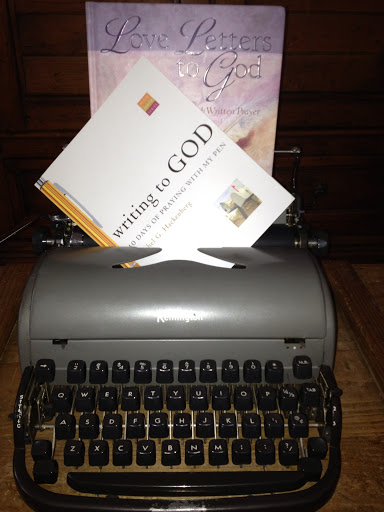
Love Letters to God: Deeper Intimacy Through Written Prayer (Lynn D. Morrissey)

This first book is beautiful like its author. I’ve read it once before, and consider Lynn a dear friend and person who has fueled my passion for journaling.

This book is more than a guide to writing your prayers to God, it is an invitation to rekindle your relationship with God as the Lover of our Souls. As I enter the pages and the stories of Lynn’s adventures with God, as well as her struggles, my heart finds rest and revival at the same time. My imagination is drawn to the garden of my soul, and I long to tarry in the presence of our Savior.

Today this line, prompted a prayer of examen: “Naming our grief is the first step toward healing.” That one sentence opened up a floodgate of griefs that I have been ignoring, afraid to name them for fear of being consumed by grief. The crazy thing is that the more I try not to name my griefs, the more they come out in anger and despair.

In my journal, I wrote: “My grief is . . . regret, dismay, denied, unrealistic, unnameable, transitional, disappointment based on sin, sorrow, sickness, separation and simple doubts about God’s goodness.” This simple act of confession brought to light what troubles me. I don’t have solutions, but expressing these on paper was the first step of reaching out to God for healing and comfort.

Writing to God: 40 Days of Praying With My Pen (Rachel G. Hackenberg)

I love the simplicity of this book. The prayers recorded in this book are poetic. They have inspired me to write poem prayers. Writing poetry takes my raging thoughts and distills them down into concise, raw expressions. When I read Rachel’s poem prayers and my own, I am drawn to some phrase that feeds my soul in the moment.

On the facing page of each prayer, she offers a prompt to read a Scripture and to contemplate a topic, which spurs me on to more written expressions of my heart.

In the poem, Nighttime Prayer, she explores her fear of the dark, which leads to her real fear–the fear of not being in control or able to stave off disaster that might come in the middle of the night. Early in the morning she laments, “Wide-eyed in case the uncontrollable, unthinkable happens/So I stay awake/Stay distracted/Determined not to be caught off guard by the night.”

Her prayer prompt for this entry explores fear: “Write a prayer about fear, and let the presence and encouragement of God surround you with holy comfort.”

Combining this reading with the quote from Love Letters about healing and grief, I noticed a connection between grief and fear.

I wrote: “My fear is . . . bound up in my grief. I fear failure, disappointing others, not keeping up, other people’s opinion of me, giving up on life, disappointing others’ expectations of me. I am afraid of depression, cancer, pain, failure, rejection, hope, renewal, new paths, success, criticism, praise, pride, the future, boredom, apathy, cynicism, nothingness, death, living, making mistakes. . .”

These confessions were random, yet real. Something about confessing these on paper enlarges my perspective.

My conclusion today was that I am powerless . . . and that’s a good thing to know and believe, because then I cry out, “I need you, Lord Jesus!”

And He comforts me.

Linking up with: