O death, where is thy sting? O grave, where is thy victory?
(1 Corinthians 15:55 KJV)
What greater tribute can a child give their parent than heartfelt words penned to celebrate the parent’s life and mourn his absence. Lynn, in her eloquent voice, does just this as she remembers her daddy.
<!–[if supportFields]> SEQ CHAPTER \h \r 1<![endif]–><!–[if supportFields]><![endif]–>Nearly six years ago, while my beloved father relinquished his mortal coil, God released his soul like a shooting star, arc-ing right through the galaxies straight to His heart. After a six-month odyssey of agony, a living death, Daddy was blessedly transformed—that quickly, that effortlessly, that mysteriously—in a breathtaking nanosecond, in the twinkling of an eye. Absent from the body, present with the Lord—absent from withering flesh to wondering felicity, from careworn burdens to contented bliss, from dark-glass knowing to face-to-face intimacy with the God he loved.
Oh, without question, I was relieved that my father no longer suffered. After a treacherous fall that broke his neck, mercifully sans paralysis, my father lay tethered to a hospital bed by a tangle of tubes and needles, a plethora of pain and indignity. He suffered more than anyone I’ve ever known. And in ways impossible to convey, we suffered with him. We agonized over all he endured.
So how could I have possibly wanted that to continue? No, I was relieved that his suffering was over.
And yet, to let him go was excruciating. How could I let go the man I’d loved my whole life, my larger-than-life hero? How could I let go his bear-hug embrace, his mammoth hands that encompassed mine or playfully crushed the hands of my would-be suitors, his beautiful basso-profundo voice, his hardy laughter, impish humor and twinkling ice-blue eyes, his constant, but good-natured prodding: “Lynn, what are you writing today?”
People offered sincere comfort: “He’s no longer suffering. He’s in a better place. He’s with the Lord.” Yes, I knew that, and yes, I was comforted, but Daddy wasn’t with me, and I grieved his loss, his tangible, physical presence, his warmth, his strength. Someone encouraged, “But you’ll be with him soon.” I knew he meant well, but soon? If I lived a normal life span, I would live without my father for at least another twenty years.
Death had torn my father away, and it was tearing me apart. Death was never meant to be, and this ripping of body from soul was unnatural. It was not what God had originally intended. So despite that I could rejoice that my father was in heaven, I still longed for him here on earth. I missed him body and soul, missed all of him, all that he was.
Ten days after Daddy died, I attended a journaling retreat, where, ironically, I couldn’t journal about him. God had always used journaling as a means of deep catharsis in my life, but after grieving in writing for six months during my father’s prolonged hospitalization, I had nothing left to say. Looking back, I realize that God was protecting me. My grief was so cavernous, that had I spilled my soul into a blank journal, I would never have been able to stop writing. I would have plummeted into a grief gorge, unable to grope my way out.
But God knew that I still needed a way to release my pain. One day, without conscious thought, I started to scratch words on a tablet—words that I hadn’t intended to write, words about my father’s physical being, the actual man I missed so much. Without initially realizing it, I was writing a poem, a much smaller container to house my grief, a far more manageable vessel for holding despair. God used this amazingly simple form of writing as an important first step in a monumental healing process.
To Christians reading this post, I remind you that I know my father’s soul is absent from the grave. His true essence is with the Lord. And yet, God made us body and soul, and when we grieve it’s important not to disregard our incalculable loss of an actual, physical person. This is the sentiment I tried to convey in “The Box.”
Oh how I long for the day when God will reunite Daddy’s body and soul in the reality of resurrection. God promises that my father will live whole in His presence, in the new heaven and the new earth. And I long for that day, when I will join my Father and my father, never to be separated.
If you are experiencing a grief too deep to bear, despair that threatens to overwhelm, might you pick up your pen and write some small, one-line descriptions and remembrances of the person you loved so well? Write a short poem or psalm of lament. Let your pen lance your wound. Let your words heal your heart.
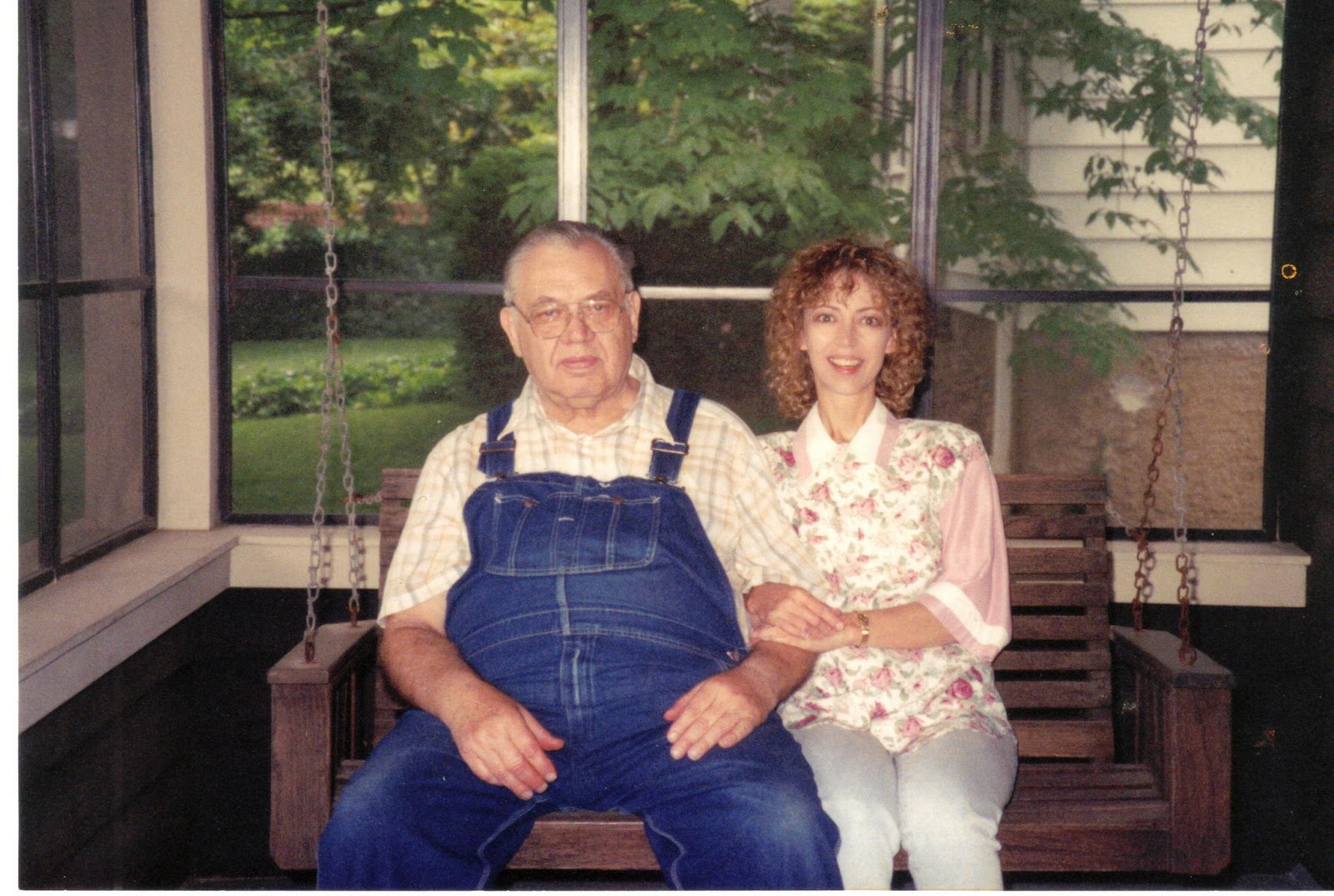 |
| Lynn with her father, Bill Morrissey |
The Box
For Daddy
Your favorite plaid shirt—well-worn, softened squares of red and blue—
was torn clean through at mid-sleeve,
and frayed—terribly frayed—where your angular elbows, roughened,
yet softened with time, thrust through.
Your dark denim overalls, homey, capacious,
deliciously splattered with rays of white paint,
like a midnight sky spattered with sprays of bright stars,
were your second skin.
Your big, black shoes (size thirteen)—you called them boats!—
anchored your once-six-foot frame to earth,
as you lumbered cumbersomely along,
your cold-steel cane flanking you, too.
You were no fashion plate.
But you had a beautiful box:
polished mahogany, smooth as silk,
filled with milk-white clouds and satin puffs,
stuffed like an elegant jewel case and adorned
with bright-brass Pieta replicas and shining panels of Lord’s-Supper reliefs.
I ran my hand along its handles, along its glistening, beveled edges,
reverently reveling in its richness,
gripping its resplendence.
And now, in grief,
in throat-stripping weeping,
we must grip ourselves.
We place our priceless treasure in the box,
carefully, oh so carefully.
We fluff the clouds, smooth the satin folds,
arrange your body like one arranges fragile flowers,
then close the lid.
And we lock it tight against the night.
We lock it hard for holding,
secure for safe, safe keeping.
2013 Copyright. All Rights Reserved. Lynn D. Morrissey

2013 Copyright. All Rights Reserved. Lynn D. Morrissey

Lynn D. Morrissey, is a Certified Journal Facilitator (CJF), founder of Heartsight Journaling, a ministry for reflective journal-writing, author of Love Letters to God: Deeper Intimacy through Written Prayer and other books, contributor to numerous bestsellers, an AWSA and CLASS speaker, and professional soloist. She and her beloved husband, Michael, have been married since 1975 and have a college-age daughter, Sheridan. They live in St. Louis, Missouri.
You may contact Lynn at words@brick.net.
Please feel free leave your comments for Lynn on this post.
 Intuition Diaries