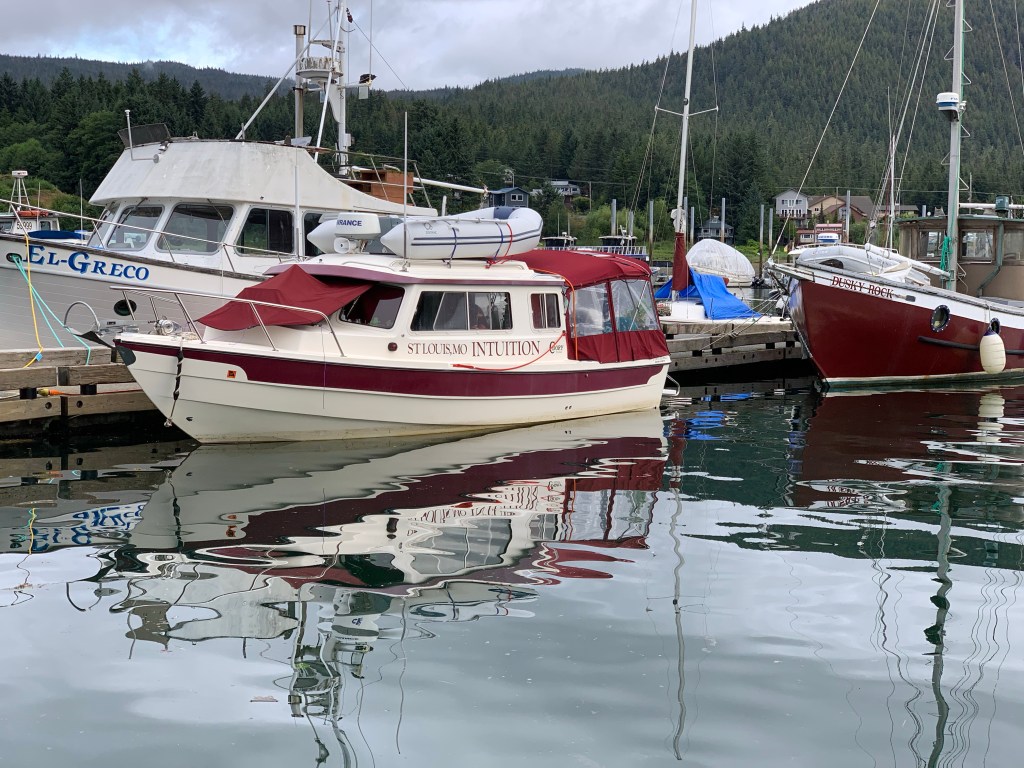
Because of the font we chose one side of the name then St. Louis MO, on the other side it is opposite.Sometimes people read this side incorrectly, and say wow it’s the St. Louis Institution. We just laugh, and say yep, it’s quite an institution.
Words by Les and Kel Rohlf
As we wait in port for favorable weather and scheduled maintenance, we thought we’d share some thoughts on why we chose a C-Dory boat, and what the name Intuition means to us.
Les’ Notes on the C-Dory Decision
Why a C-Dory
When we first considered buying a boat roughly 12 years ago, we knew little about the design intricacies of boats but wanted something that would support our desire to explore. Specific requirements included the ability to store and move it via trailer. Results of my searches for “pocket cruiser” and “trailerable cruising boat” included C-Dory boats. C-Dories and several other similar pilothouse cruisers are built in the Pacific Northwest and are popular there due to their enclosed helm and cabin.
Research on the C-Dory brand led to my reading Bill and El Fiero’s accounts of their decade of travels in a 22-foot C-Dory cruiser: http://cruisingamerica-halcyondays.com/. Their narratives expanded my view of what might be possible with a smaller boat. I also found and began lurking on the C-Dory internet forum (c-brats.com), whose members provided excellent real-world information. Based on reports from those with experience, I understood that C-Dories and similar boats were suitable for longer and more complex adventures like the U.S. Great Loop and Pacific Northwest/Alaska.
Since every boat is a compromise, each person’s value calculation will be different depending on their planned uses and budget. C-Dories had appeal to us for their relatively simple design and components, reasonable operating costs, and good value (can’t use “low cost” when talking about boats). As it turns out, there was a C-Dory dealer in St. Louis who had a 25-foot cruiser in stock. It was a two-year-old model they had used for demos. They offered it for a reasonable price, especially considering we didn’t have to travel a great distance to buy this boat. Thus began our powerboat ownership adventure.
Here’s what we’ve learned from our experience with this particular boat:
Being trailerable has been critical to our style of use. We can quickly take it to a specific area we want to explore. Because of its portability, we’ve been able to do sections of the Great Loop in 2- to 3-week segments during vacations, the Erie Canal, a circumnavigation of Lake Michigan, most of the Cumberland and Tennessee Rivers, and the upper Mississippi from St. Paul to Dubuque. I believe a boat stored on a trailer also simplifies, and to a certain degree, reduces required maintenance.
The shallow draft of our boat (approximately 18 inches) allows us to navigate through and anchor in areas that may not be accessible to larger boats whose hulls require additional depth.
The C-Dory 25 Cruiser is one of the smallest boats with all of the following functionality:
Sleeping quarters for two
Galley with sink and cooktop
Pressurized water system, Head with toilet and shower
Dinette
Refrigerator
We’d need to upsize to a 30+ foot boat to get significant increases in space and amenities (like separate shower, walk-around bed), at which point portability becomes more challenging.
The C-Dory’s hull has a flat aft bottom that makes it very efficient (150hp outboard provides sufficient power for speeds near 30 mph with a light boat), The flat bottom, however, is not well suited for larger wave conditions, as it tends to bob over or “pound”, rather than cut through waves. While we knew this going in, it’s hard to appreciate until you’ve experienced it. Our approach is to avoid waves 3 feet or higher whenever possible. During our trip this summer, we prioritize travel for days when the wave height is forecast to be “two feet or less.” This is a compromise we’re happy with, since a boat with a deep-V hull design requires significantly more power (along with greater complexity and operating costs) to provide similar performance.
Is a 25-foot C-Dory the best vessel for cruising Southeast Alaska? Perhaps not, if the decision was limited to that purpose alone. There are days when a little more space or a little more speed or a little larger water tank would be nice, but I’m not eager to give up the other benefits of a 25-foot trailerable boat. In our case, we appreciate that we have a boat capable and sufficient for this trip without losing the other benefits that led us to this model. The C-Dory continues to be ideal for our boating priorities.
Kel’s Musings on the Choice of Intuition
When Les first brought up the idea of getting a boat, I was surprised. Neither one of us grew up boating. Both of us enjoy outdoor activities, and have dabbled in backpacking, canoeing, bike touring with camping gear and local hikes now and again. Even though neither one of us considered ourselves boaters, we liked the idea of traveling by water and seeing new places. For us it was a great midlife “hobby” to pursue together.
I had always wanted a pop-up camper to get out in nature, so when I first toured the inside of the C-Dory I was hooked. Inside the cabin feels like a mini camper. A cozy bed, a sink, stove and mini fridge, the kitchenette, which converts to a single bed or chaise lounge, if I feel like spreading out, and the toilet with a shower, sort of. (At the time, I thought the shower was pretty cool, but have learned that showers are all relative.) Like Les mentioned, since its trailer-able we can haul it across the country for vacation or over to our local haunts on the Mississippi River for a weekend getaway.
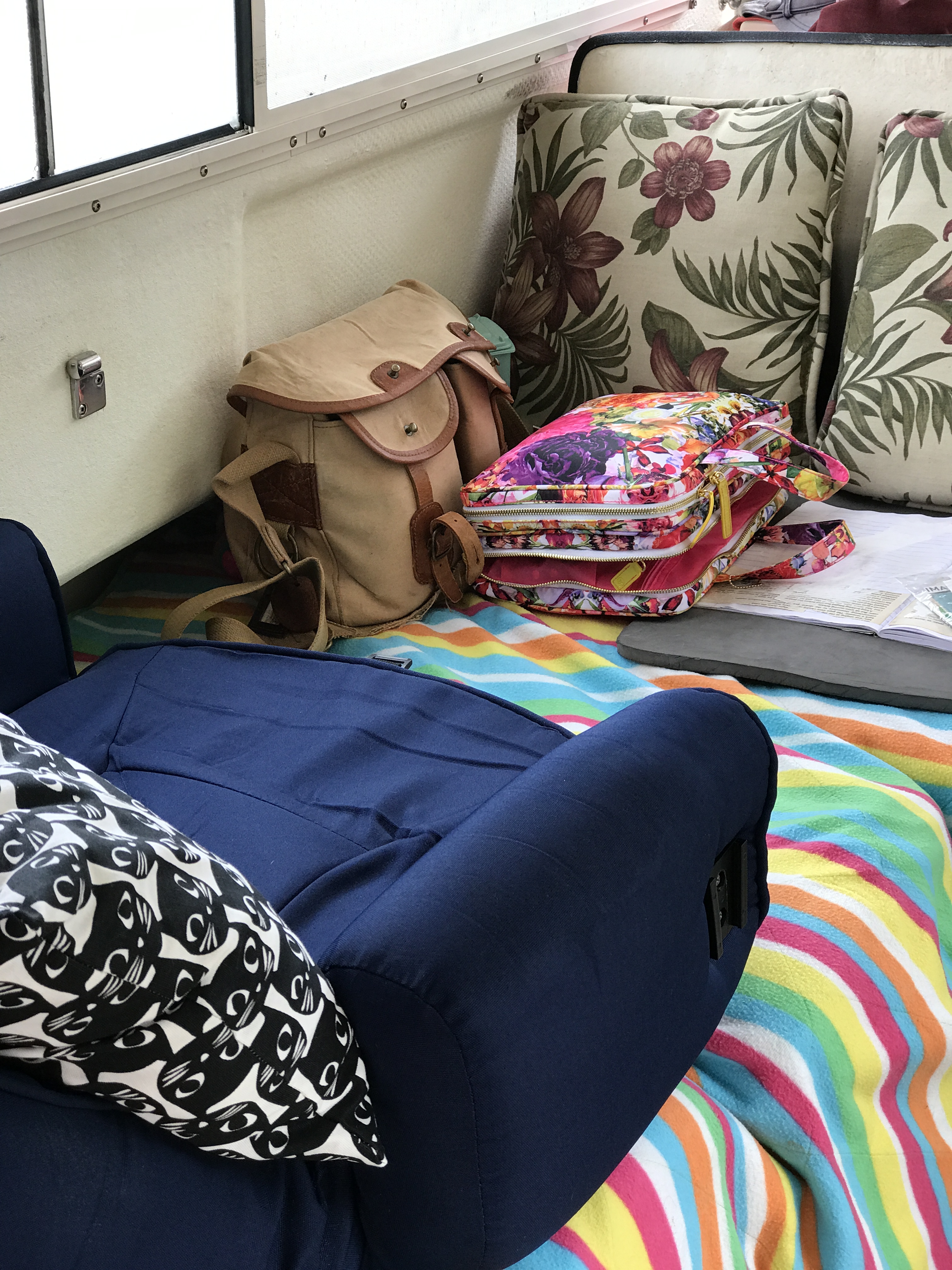
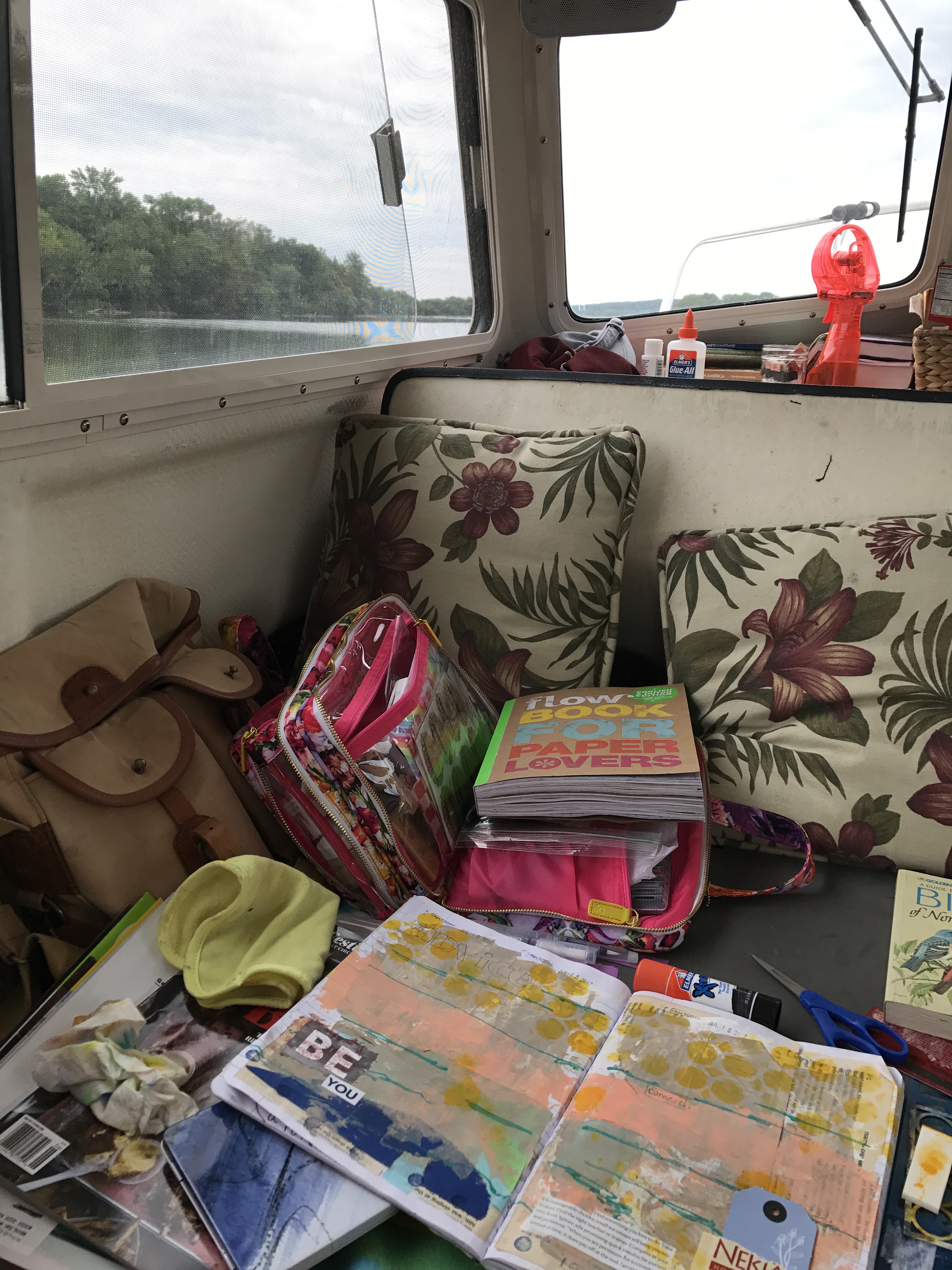
The kitchenette converted into my chaise lounge (Upper Mississippi trip 2017)My lounge covered with art supplies (Upper Mississippi trip 2017)
We took the boat for a test drive over in Alton, Illinois with the dealer on a rainy October afternoon. We were snug inside the cabin, and loved the simplicity of the fiberglass walls, ceiling and floor, which are fairly easy to keep clean. After helping the dealer get the boat back on the trailer in the rain, we drove home. On the drive home, I knew we had found our boat.
While we were still mulling over the decision to buy it or not, we discussed naming the boat. And the name, Intuition, popped into my head. I shared it with Les, and he liked it.And that’s the name we chose. Pretty basic, but I like to embellish things, so I could tell you that my intuition prompted the name, or that it’s a play on words like, “we’re dipping IN-TO-the kids-TUITION to buy it. But truly it just occurred to me, and we both liked it. Of course, if Les had picked the name it would have been something like Logic. (But as we all know a women’s intuition is always right.)
The other thing that I liked about the word intuition was its Latin roots:
from Late Latin intuition-, intuitio act of contemplating, from Latin intuēri to look at, contemplate (www.m-w.com)
The Intuition is our refuge where we like to go to contemplate, to relax, to look at life from a fresh perspective.
A good name is rather to be chosen than great riches, and loving favor rather than silver and gold. (Proverbs 22:1 KJV)
Words by Les and Kel Rohlf Photos by Kel Rohlf unless otherwise indicated
Les’ Notes
Monday – Wednesday, August 2-4
Sitka
On Monday, we walked downtown to see what may be available for later days. There’s a small (700 pax) cruise ship in port today, so the downtown wasn’t too busy. There’s a larger ship scheduled for Wednesday, so that will be the day to avoid. We had a nice breakfast at the Mean Queen restaurant downtown.
On Tuesday, I got an appointment for a haircut with Malcolm at the Old Tyme Barber Shop to remove nearly 3 months of growth. We had a delicious lunch at BEAK, which is in the historic Cable House that now also includes KCAW, the local community radio station.
I hiked past Crescent Harbor marina and visited Sitka National Historic Park. The historic park had a very extensive collection of original and reproduction totems from southeast Alaska as well as a nice history of the local Tlingit clans and photo collections of E. W. Merrill. The fascinating photo collection from the late 19th and early 20th centuries is available to view on the park’s web site (https://www.nps.gov/sitk/learn/historyculture/e-w-merrill-photograph-collection.htm).
Photo Credit: Les Rohlf
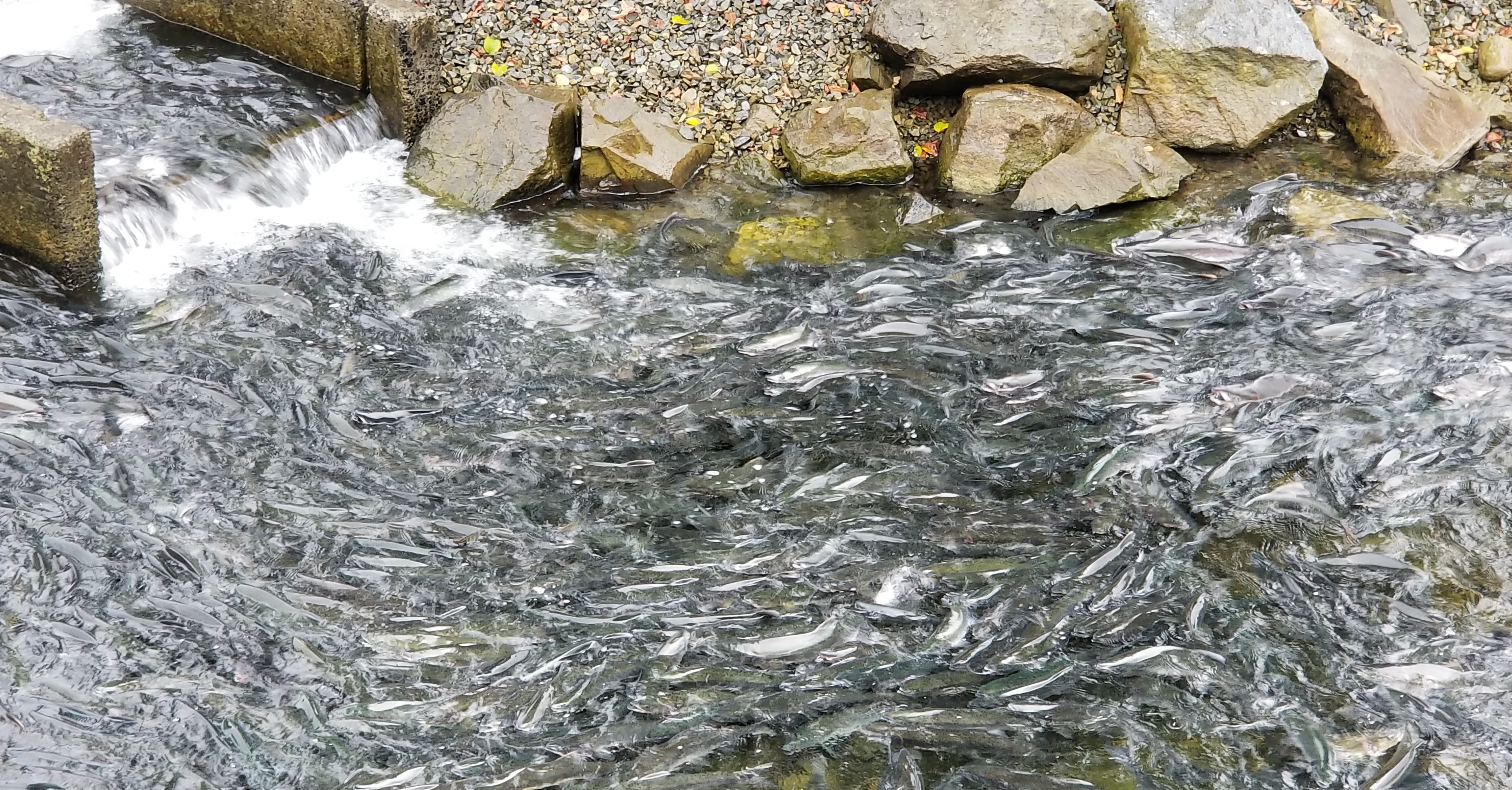
On the way back toward downtown, I stopped at the Sitka Sound Science Center and Sheldon Jackson Hatchery and took the hatchery tour, as the Pink Salmon were returning to spawn. This is the oldest operating salmon hatchery in southeast Alaska, raising and releasing Pink, Chum, and Coho salmon (https://sitkascience.org/hatchery/).
Fish Ladder in Ketchikan Creek (Photo Credit: Les Rohlf)
Salmon Climbing Ladder in Sitka (Photo Credit: Les Rohlf)Salmon in Sitka Hatchery (Photo Credit: Les Rohlf)
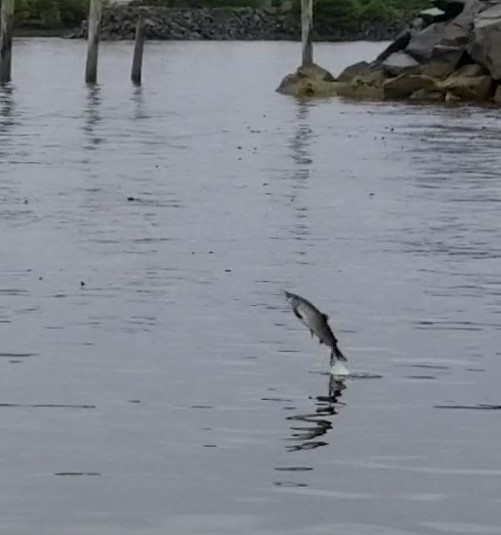
Salmon Jumping (Photo Credit: Les Rohlf)
On Wednesday we prepared for the next phase of our trip to explore bays off Chatham Strait. I was hoping to get water in Angoon or (worst case) Kake during the next week, as that’s the commodity we’ll likely use most quickly. Unfortunately, nobody I called at either town seemed to know whether fresh water was available at their harbors, and the harbormaster didn’t answer their lines. I bought a collapsible 5-gallon water container and filled it in Sitka to carry as reserve.
Thursday, August 5, 2021
Sitka to Baby Bear Bay
Baby Bear Bay sunset (Photo Credit: Les Rohlf)
Miles: 39
Hours: 6.7
We took a last shower in Sitka and had a relaxed breakfast before departing. Slack at Sergius Narrows (30 miles from Sitka) was at 3:54 pm, so there wasn’t any reason to start early. We left shortly after 9:00 am and made a circuit south to Sitka Sound and then around Japonski Island to pick up the route north. Japonski Island includes the Sitka airport, hospital, and Coast Guard station. Its location creates a protected channel along which the Sitka Harbors are located. Along with numerous other smaller islands, it provides a protective barrier for Sitka from the Pacific Ocean. Today was the first clear and sunny day we’ve had in Sitka, allowing unobstructed views of Mount Edgecumbe.
The water was smooth all day, and we arrived at Sergius Narrows 90 minutes prior to low slack. The section immediately below the narrows where we’d seen some turbulence on Sunday was fairly calm, and I didn’t see any large waves or rapids when I looked into the narrows through the binoculars. I had just watched a larger cruiser motor up through the narrows, so I decided to go for it. Probably not the most prudent choice. I throttled up to max power, which normally gives me 18 mph with my fully loaded boat. I saw 14 mph speed over ground on the GPS as we entered, which didn’t surprise me as I expected up to a 4 kt current. The section of the narrows I couldn’t see from the lower end included a faster current that clearly deflected the buoys, along with a section of sizeable (2-foot) standing waves. Through this section I saw my speed on the GPS decrease to 10 mph. We had good directional control through the worst 200 yards or so of the narrows, but this would have been a very bad idea in a slower boat.
We continued just a few miles farther and entered Baby Bear Bay to anchor for the night. After slowly circling the bay to the end and allowing a group of kayakers from the parked small cruise ship to exit, we dropped the anchor near the head of the bay in about 40 feet. The end of the small bay is a 90-degree turn off the main bay and ends after another few hundred feet. Our anchor spot was conservative and would conceivably allow another boat to anchor between us and the end of the bay.
Just after I finished tying everything off and re-entering the cabin, a 60-foot Selene entered the bay. Without any attempt at communication, he passed within 50 feet of us and into the head of the bay. I initiated a radio call to him to let him know there was probably room, that he was over the top of my anchor at that moment, and that we were currently at the eastern-most end of our anchor swing. I didn’t mind that he wanted to anchor beyond us, but was slightly annoyed that he went closely around us to anchor without acknowledging. Perhaps he’s far more familiar with this bay than I am and was comfortable with the situation. In any case, it took a couple tries before he was able to place the anchor where he wanted it, given the limited space.
Friday, August 6, 2021
Baby Bear Bay to Hanus Bay (Portage Arm)
Miles: 35
Hours: 5.9
We left Baby Bear Bay at 8:00am, shortly after low tide. We motored slowly through the couple miles of turns toward Peril Strait, getting a nice boost from the incoming tide. Once in the main east-west section of Peril Strait, the incoming tide switched, forcing us to work against it after that.
I wanted to arrive at today’s destination at high tide to verify sufficient depth, since we’ll be leaving at or near low tide tomorrow. The guide shows two entrances to Portage Arm of Hanus Bay: entering from the west forces you through shallow water; entering from the east requires you dodge submerged pilings. I chose the former. On the line I selected, I saw at least 19 feet, so shouldn’t see less than 6 feet early tomorrow.
There was a large bear on the Catherine Island side of the portage when we arrived, but he didn’t stick around after I started to circle and survey the anchorage. The anchorage is described in one of the guides as “shallow”. From my perspective it was ideal, with about 25-foot depths at a 12-foot tide. This marked one of the few times I was able to anchor comfortably without having to put out nearly 200 feet (or more) of rode.
The weather forecast from this morning wasn’t quite as rosy as before we left Sitka, and it seems to be going in the wrong direction as of this evening. There are a couple different systems that could dump 3-7 inches of rain on the region through the end of next week. Of greater concern are the winds and resulting sea state, which may make it difficult to get back to Auke Bay late next week if we continue south in Chatham Strait. On Monday, we confirmed with the shop in Auke Bay to service our motor one more time on August 17th. We plan to leave Auke Bay after that to start our return trip south. We don’t want to risk missing that appointment, and getting 130 miles back to Auke Bay may be challenging if the weather stays as forecast through the end of next week. Tomorrow looks favorable for travel, but the conditions will deteriorate rapidly on Sunday.
Saturday, August 7, 2021
Hanus Bay to Auke Bay
Miles: 93
Hours: 6.9
The latest weather forecast as of early this morning confirmed our tentative plan from last night to at least start back north toward Juneau today. Today looked good for travel on Chatham Strait and Southern Lynn Canal, but the winds and waves are forecast to gust to 35 knots and 5 feet beginning Sunday.
At 6:30 am we carefully made our way through the shallow westerly exit from Portage Arm of Hanus Bay and turned toward Chatham Strait. We ran at 4200 rpm, which kept me at 14.5-16 mph all day long. It was a cloudy, sort of foggy day as we ran north up Chatham Strait. I crossed to the east side of the strait early on to the get some relief from the southeast waves on the beam. The shelter of Admiralty Island helped smooth the ride, which was fairly comfortable for the remainder of today’s trip. There were a large number of seining boats working the bays on the eastern shore.
It was a nice Saturday, so there were lots of fishing boats to pick our way through after passing Funter Bay. We arrived at Auke Bay by 2:00pm and were fortunate to find a spot in the marina close to one of the electric distribution boxes on D-dock. It seemed less busy than our last time here in mid-July, though the marina did fill up by evening.
For now, our plan is to hang out here until the motor is serviced on 8/17. We stocked up in Sitka assuming we’d be out for a week, so there’s no hurry to get groceries. The forecast as of Sunday morning continues to look ugly all week, so thankful we made the decision to get here sooner than later.
Kel’s Musings
A couple notes: when I post the “hours” from Les’ notes, it is referring to the number of hours we used the motor, not necessarily how many hours it took us to travel in a given day. Second, the following musings were undergirded by a new concept/word that a friend shared with me recently. Sonder is word coined by John Koenig, which he defines as “n.– the realization that each random passerby is a living life as vivid and complex a your own.” Here’s a link to a video excerpt from his book, The Dictionary of Obscure Sorrows, coming out in September 2021.
Moored at dock in Auke Bay Harbor
A lot can change within a week of boating. We arrived in Sitka on a Sunday afternoon, and now this Sunday afternoon, we are writing from Auke Bay. When we left Sitka on Thursday, August 5th, we were planning a ten day excursion to explore bays we hadn’t seen yet.
Our last day in Sitka we did laundry, ordered breakfast via the McDonald’s app (only their drive-thru was open) and stocked up on groceries. Thursday morning we took hot showers at the marina with no incident. We took a nice leisurely route out of town around the bay to look at the open ocean and see the town from the water. I caught up on the phone with our youngest son as we left Sitka; cell coverage on the water is very sparse. We were ready for lazy days ahead, reading books, enjoying nature and shorter cruises on the boat, plus one cove included a warm springs, which we hoped to soak in one afternoon.
Before all those preparations, we did find some fun things to do in Sitka. We watched the boats come in and out of the dock area, and float planes land across the channel from us. The Sitka airport was on the island across the way, and so we could hear the Alaska Airlines arrive and depart. We had a front row seat to all the movements of people coming and going in Sitka.
On Monday, we walked into downtown. Most marinas in Southeast Alaska are about a mile from the main tourist areas, so walking is our main mode of transportation while in port. Les maps out our routes on land and sea. While we walked past the fishery, lodges and Scotty’s place (more later), I asked why we didn’t walk through uptown. He replied this is the shorter route. I replied, oh, as we swatted “no-see-ums” or gnats that were congregating near the fishery. Once in town, we noticed how quiet and empty it seemed. We found the chocolate store, the thrift store and the souvenir stores, which were just opening or didn’t open until like 10am or later. We had breakfast at the Mean Queen, and our server was very friendly and the food delicious. We watched as one of the bigger cruise ships arrived, and planned to be out of downtown before the tourists arrived. We spent the rest of the day relaxing.
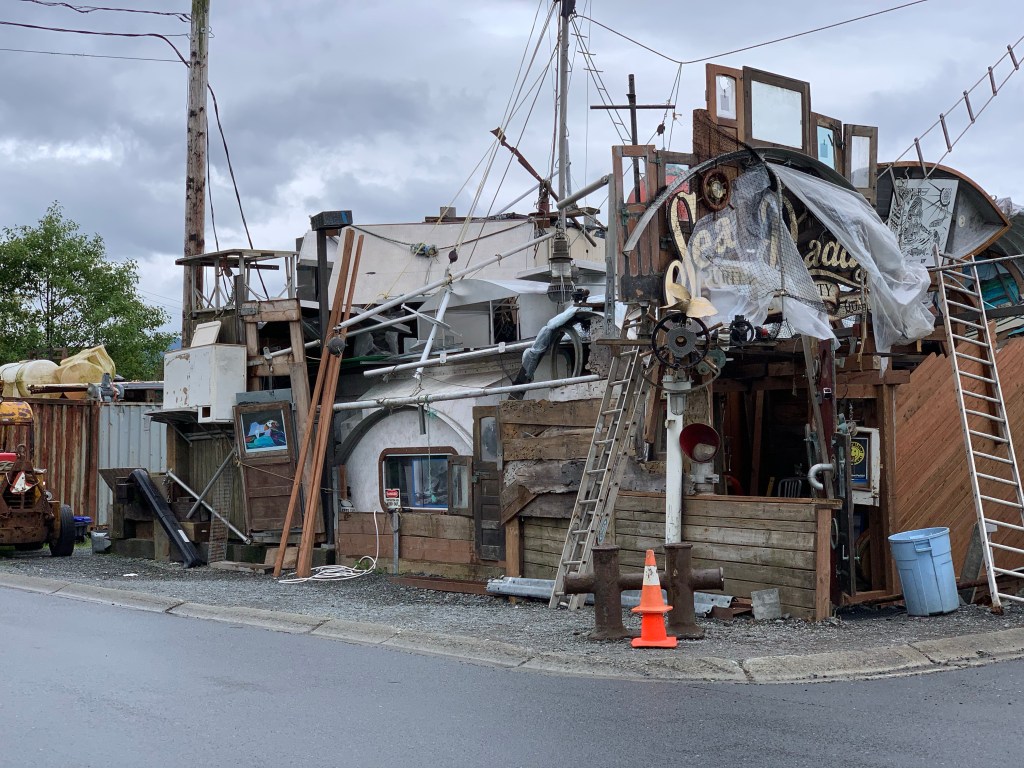
Tuesday, Les scheduled a haircut, and I met him there walking via the fishery road, because it was shorter. (We had walked back through uptown the day before, and indeed it was longer and steeper.) The “no-see-ums” seemed to have gone elsewhere. On my way to the barber, I met Chas. He was walking ahead of me, and paused at an intersection just as I was coming up to Scotty’s place. Scotty’s place is a mish-mash of marine objects and ladders and container-like buildings that reminded me of a sculpture. I paused to snap a photo, and Chas started up a conversation with me, and we chatted as we both walked toward town.
Scotty’s Place
Back to Scotty’s place. Les found out from the barber, Malcolm, more about the place. Scotty had dreams of opening a fish and chips shop, but the city wouldn’t grant him a permit. So Scotty just lives there, and for some reason no one has asked him to move.
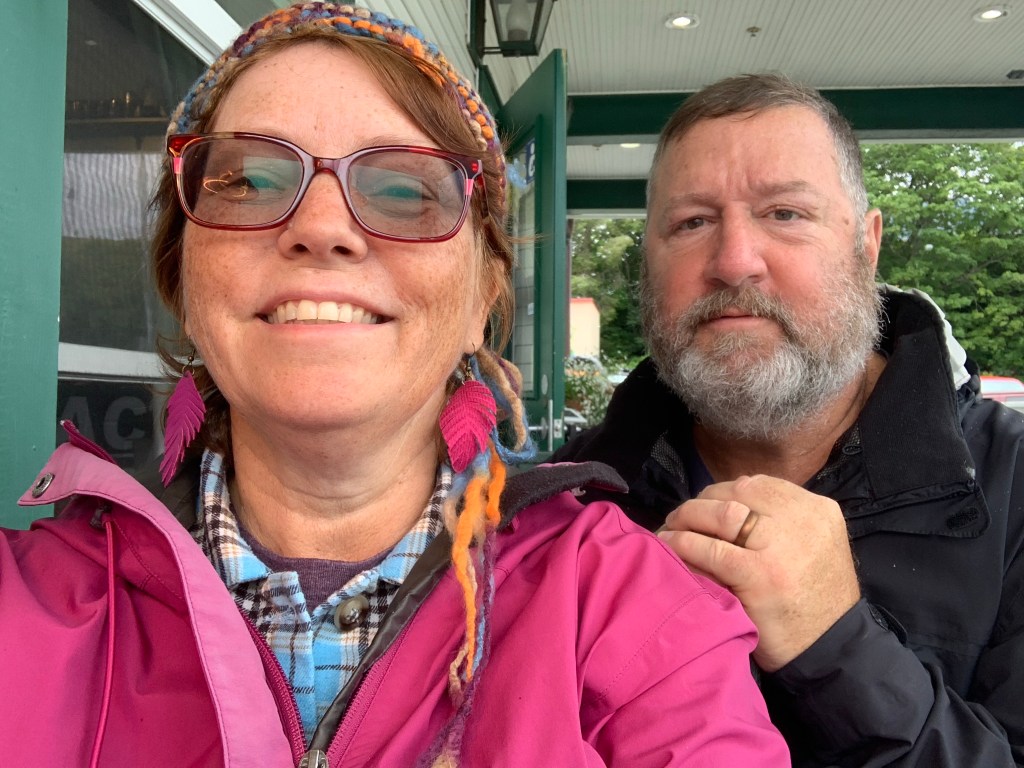
Chas was originally from Anchorage and had recently retired. He told me the secret of his 51 year marriage was that he came to Sitka for a month at a time to live on his boat, while his wife travelled to visit the grandkids. He complimented me on my earrings, and we shared pictures of our boats with each other. It was nice having some company on my walk to meet Les at the barber shop. After Les’ haircut, we strolled around Sitka. We stopped in at the Visitor’s center to pick up brochures and a map. The volunteer was chatty, and shared how she and her husband recently retired and traded in their 22 foot sloop for a bigger cruiser. They had to buy it in the Seattle area and then bring it up here via the British Columbia waters and the Inside Passage. It was fun to swap stories with her, as we told her of our adventures on the Intuition.
We headed to a bike store and a craft store before ending up at the BEAK for lunch. It was drizzling, and thankfully their outdoor seating was under a porch. We had fish tacos and reindeer sausage mac and cheese. After lunch Les and I parted ways. He was off to check out the local museum, and I was going shopping. Both of us enjoyed our separate adventures. I ended up at the local bookstore, and hoped to enjoy a coffee in their café. I found two books pertinent to our journey, Names on the Chart, describing how various waterways came by their names in Southeast Alaska and John Muir’s Book of Animals, an illustrated volume with a compilation of musings by John Muir of the local wildlife.
The café was crowded, so I stopped at the chocolate store for a latte. And a homemade white chocolate bar with vanilla wafer bits, malted chocolate bits and colorful sprinkles. Les met me back at the boat, and shared his stories of finding a salmon hatchery and totem pole park, rather than going to the museum. That evening I went for a run through uptown and then back through downtown. The evening seemed a little livelier, especially at the saloon, Sitka Hotel restaurant, and a local bar. As I cooled down from my run, I walked past Scotty’s and a gentleman was standing near an abandoned clapboard house. He was reading the Sitka Sentinel. As I walked by, he reported to me that tomorrow the town would be receiving 2,104 cruise boat tourists. I thanked him for the news, and commiserated a little bit with the invasion of his quietude.
While we didn’t go to some of the usual haunts of Sitka, once again we enjoyed the discoveries we made on our own. Highlights for me were meeting people, buying a pair of jeans at the thrift store, shopping at Ace Hardware store (they had cool stickers), ordering delivery for pizza and a halibut wrap, watching the sunset on the channel, and “living” like a local except for the souvenirs that I bought.
Souvenirs
We left Sitka ready for the next phase of our journey, some extended time living on our boat and dropping the anchor wherever we fancied. The first night we stayed in Baby Bear Bay. My expectation was that most of these bays were remote, and we’d be alone. Right after we anchored, another boat buzzed into the bay right past us, and anchored in front of our view. So much for solitude.
The next day we left early to get to Hanus Bay. When we arrived, we noticed a bear grazing along the shore. We were busy dropping the anchor, so no photos. We settled in, and waited to see if anyone else would join us in the bay. Nope. Now, I was lonely for some company. It turned into a gray, rainy afternoon. Les was listening to weather, and checking tide charts. The forecast was for calm waters on Saturday, and then winds and rain were predicted for the entire coming week. We prefer the waves to be 2 feet or less while traveling from bay to bay. We talked it over and thought about running south to the Warm Springs on Saturday, then hope for decent weather on Sunday to get halfway back to Auke Bay harbor, then go the rest of the way Monday. But the more we listened to the weather, the more it became evident that it would be better to trek the 93 miles to Auke Bay all in one day. We were disappointed, but also knew we could possibly stop in these southern points on our way back down to Ketchikan.
We are now happily moored at Auke Bay harbor on the 10 Day Transient docks with shore power, and amenities like shower, laundry and food within walking distance, plus access to the bus system. Auke Bay is part of the metro Juneau area. If we want we can take the bus to the suburban shopping centers or back to the downtown area that we explored a couple weeks ago. We will stay here through next Tuesday, August 17th, as we have hit the point of 100 hours on the motor, meaning its due for the routine oil change. The other mile marker we hit on this trip, as we pulled back into Auke Bay; we have travelled over 2000 miles on the waterways from Everett, Washington and all the various stops here along the Inside Passage.
As we have this respite from cruising the waterways, my heart knows that this is the beginning of the end. Summer is waning, the flowers are starting to droop, the birds seem quieter, and familiarity rather than heightened curiosity seeps into our days. I will still be on the alert for discoveries and surprises, but I also will be savoring the gifts of Alaska, while silently say good-bye little by little as we cruise back south in a week or so.
“life is a pilgrimage in which you put aside your plans to set out on a journey, allowing yourself to be guided, accompanied, open to surprises.” (Excerpt from Walking with Ignatius)
“And how blessed all those in whom you live, whose lives become roads you travel; They wind through lonesome valleys, come upon brooks, discover cool springs and pools brimming with rain! God-traveled, these roads curve up the mountain, and at the last turn—Zion! God in full view!” (Psalm 84:5 The Message)
Words by Les and Kel Rohlf Photos by Kel Rohlf (unless indicated otherwise)
Kel’s Musings
I thought I’d share my thoughts first this time, just to change it up a little bit. We really appreciate all the wonderful encouragement and feedback from folks as we spend this summer in Southeast Alaska. Your comments here, on Facebook and the C-Brats forum gives us a sense of camaraderie in the midst of our solitary living. While each of us have a penchant for solitude, Les more than I, we both appreciate community and knowing that we might be bringing a sense of awe or joy into someone else’s life.
I often take the book Gift From the Sea by Anne Morrow Lindbergh with me on beach vacations, and even though we are living on the ocean, I didn’t think to pack it. (My main reading goal for this trip has been to finish Moby Dick, which I am happy to report I hit the halfway point, according to my Kindle reader.) Lindbergh’s book opened my heart to the idea that it is okay to want, need, or desire solitude. I’ve read it at different seasons of my life and our marriage, and each time it opens up in me a fresh perspective on the dignity of each individual and their need to pause and take a break from the regular routine of life. And obviously this trip, which we are on right now, is a huge break from the usual way we live.
Buoy marking entrance to Peril Strait
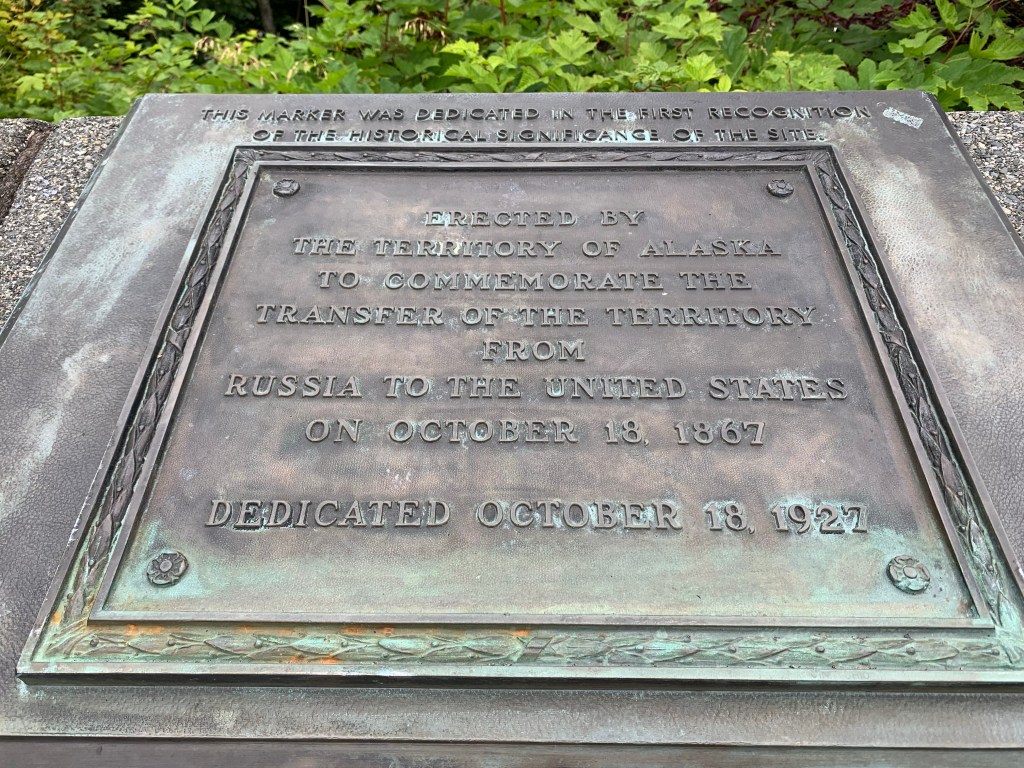
Yet we are still the same two people who met and started a life together many moons ago. And yet, we are different. We’ve grown. We’ve discovered different needs and desires that were latent in our younger years. We’ve adapted to our changing selves, and most likely in some fashion the Intuition strengthened our partnership, companionship and love for one another. (I know this is a blog entry about boating, but it’s also about relationship.) As we passed the buoy that marks the entrance to Peril Strait, I noticed it was numbered 35. I jokingly said we’re entering the peril of our married years now, since we will celebrate 35 years in October. Coincidence, harbinger or just a buoy marking a channel? Before getting to Sitka, we looked through the Visitor’s Guide magazine to see which attractions caught our fancy. I noticed that Sitka celebrates the Alaska Day Festival in October. They commemorate the transfer of Alaska from Russia to the United States; the signing took place here in Sitka on October 18, 1867. We were married on October 18, 1986. Coincidence or just something to connect us even more to Alaska?
When we left Hoonah, I felt we were leaving a familiar place, we had stayed in slip D-11 each time we came into port. We were moored between boats named Crystal Sea and Stormy Sea. This time in Alaska, we have not been on any stormy seas; mostly calm waters and a few snotty days. Just like life sometimes it’s all sunshine and merriment, and other times it’s treacherous and disappointing.
I was excited to try something new in Tenakee Springs (the bath house fed by warm springs), and was looking forward to some local homemade bakery goods. But instead, it just felt too hot and sticky to enjoy the bath house and the bakery was closed and the horseflies were chasing us back into the refuge of our boat. (We do have a fan, so that and a breeze kept us cool.) I walked on the beach to pick up treasures, I found a few things for my recycled art projects, but the horseflies soon got the better of me.
Gifts from the sea (Tenakee Springs beach near marina)
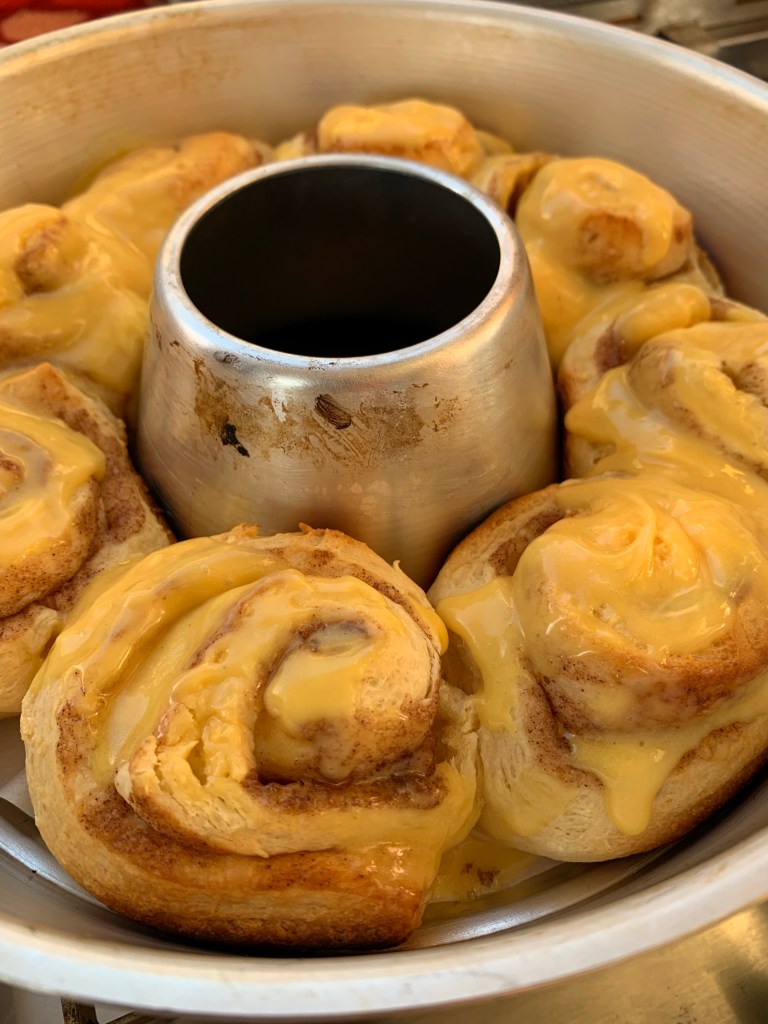
So to be honest, I went to bed disappointed that the town seemed zipped up, and we couldn’t get outside because of flies. The next morning was cool and calm, and we were going to anchor out, so no need to interact with people or worry about dashed expectations. I settled in by baking cinnamon rolls in our stovetop baker, and brewed our morning coffees.
As we were munching down our rolls, and sipping coffee Les noticed the spouts ahead. We puttered towards them, and then after a bit he surprised me by going a little faster, and I asked if he thought I should get the camera out. Yep, he replied. To our great delight, and to the benefit of my “work” as one of the main trip photographers, we indeed got lots of photos. We had been close to a single whale once or twice, and knew that they spouted then surfaced, and then dove, which was my cue to get ready to catch a tail with the camera. We knew they breached, but weren’t expecting it. We figured once they dove, they’d swim a quarter mile away and our watching would be over. Instead, just as I rested my camera, one lunged out of the water and went kersplash. I did catch the splash.
Splash from breached whale
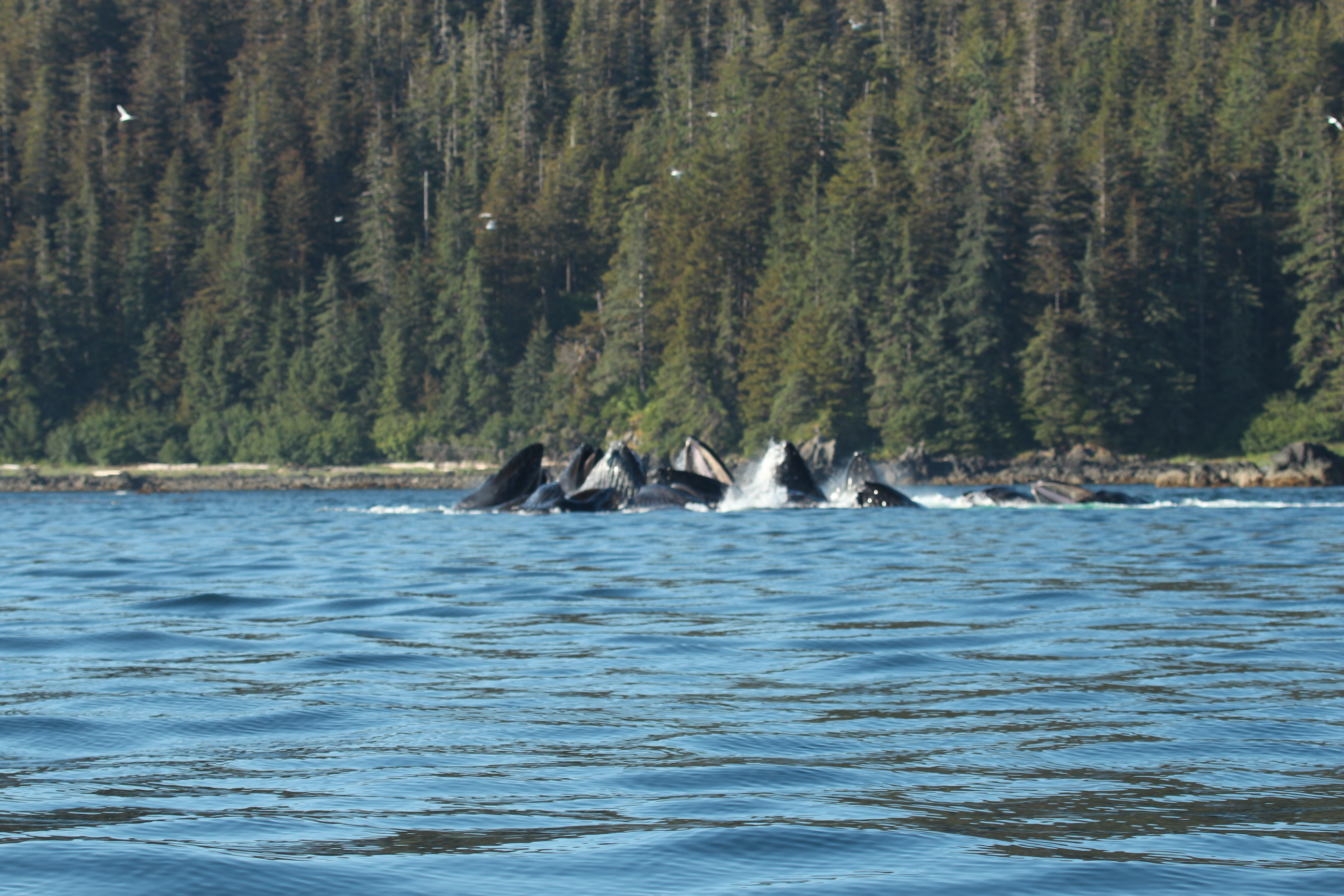
We kept following the spouts, and the circling gulls which indicate whales are below. To our surprise the whales just kept surfacing, diving and occasionally breaching. And one very adamantly kept slapping its tail. After all that ruckus, my arms ached from holding the camera steady while the boat bobbed. Then Les said, look at the bubbles, that means they’re bubble-net feeding. I had never heard of it. Apparently humpback whales make a circle and blow bubbles to “capture” the fish. One of them signals the group and they all come up with mouths open to feed. We watched them once, and then the next time I just kept the camera clicking to catch them in action.
Life surprises us like that, one minute I’m adjusting my expectations and the next I’m wowed beyond my expectations. I am thankful for the ebb and flow, the natural rhythm of highs and lows, because to stay in one state longer than another is not emotionally sustainable. We were designed for ups and downs, joys and griefs, to celebrate and to mourn, to wonder and to doubt.
I like how Anne Morrow Lindbergh introduces her narrative essays, “I began these pages for myself, in order to think out my own particular pattern of living, my own individual balance of life, work and human relationships…but as I went on writing…I found my point of view was not unique.” She goes on to explain that she thought she was alone in her need to grapple with life balance, and she envied those who had “smoothly ticking days.” And then she realizes that she is not alone in her need for a contemplative life. She concludes, “Even those whose lives had appeared to be ticking imperturbably under their smiling clock faces were often trying, like me, to evolve another rhythm with more creative pauses in it, more adjustment to their individual needs, and new and more alive relationships to themselves as well as others.” While Lindbergh discovered these insights from the leisure of time alone at the beach, I have found that we can create our own solitary retreats even when we’re not on a trip of a lifetime.
In the visitor’s guide for Sitka, it first welcomes the traveler and then states: “Travel is many things to many people.” And follows up with some rhetorical questions. We could substitute the word travel with contemplation or solitude or quality of life. I was talking on the phone with my mom when we arrived in Sitka. She mentioned she was working on eating better, moving more and staying creative, not so much to live longer, but to enjoy a greater quality of life. Her thoughts dovetailed into my musings. That’s what I am seeking when I travel or seek solitude, I’m searching for a quality of life, not necessarily something better or different.
I agree with Lindbergh, “…since I think best with a pencil in my hand, I started naturally to write.” Writing helps me process life. Questions prompt me to think. I think I’ll go grab my pen (I prefer pens over pencils) and contemplate the questions in the visitor’s guide. Here they are in case you like to think while writing. Feel free to change the word travel to whatever fits your situation. Maybe you are vicariously traveling with someone. Who knows, right?
“Do you travel to explore new cultures? To open yourself to new ideas or ways of living? To smell, taste and touch the unimaginable? Do you travel to share the world with a special someone or your children? Or do you travel to find yourself?” (Questions from the welcome page in the 2021-22 Sitka Official Visitors’ Guide)
Les’ Notes
Thursday, July 29
Berg Bay to Hoonah
Miles: 43
Hours: 5.0
Took our time heading south out of Glacier Bay to take advantage of the ebb tide. We transited the park boundary just after 8:00am, which is when the National Park Service begins monitoring radio traffic for boats entering and departing Bartlett Cove and the park itself. It was a free-for-all for about 15 minutes while everyone reported their entry/exit/movement.
Boats lined up for gas dock in Hoonah
We had an uneventful run back to Hoonah, arriving to a traffic jam at the fuel dock. Rather than waiting for 3 much larger boats to fill up (seems there’s only room for one boat at a time here), we tied up to the public dock outside the marina. It’s close to the grocery store, so Kel made the grocery run while Les coordinated for a slip for the evening. The afternoon and evening consisted of stocking up, cleaning, and rearranging everything for the 3- to 4-day trip to Sitka. The evening was focused on finishing and posting to blogs.
Friday, July 30, 2021
Hoonah to Tenakee Springs
Miles: 51
Hours: 5.5
Left Hoonah by 6:30am and worked to upload a few more photos as we exited the harbor and the cell signal faded. We made breakfast after turning east into Icy Straits and heading toward Chatham Strait. Winds weren’t strong, but coming out of the north created low waves on the beam. We fought the rising waves and ebb tide until turning south into Chatham Strait. There we got the benefit of the ebb tide southward in Chatham Strait. We accelerated to 15 mph in the relatively calm water. The further south we went, the more the waves built. While it wasn’t a terribly uncomfortable ride, the partly port-side following waves made for a busy driving experience.
Tenakee Springs marina
I was glad to make the turn into Tenakee Inlet, where everything calmed with protection from the northerly waves. We pulled into and docked at the Tenakee Harbor just before noon. Tenakee Springs is a cute town of houses built along each side of a single gravel road that parallels the water. The harbor sits about a half mile east of the central part of town. Guides indicated there was a general store and bakery/café in town, so we made that our first order of business. We grabbed a couple items from the small store (hours are 10-1); unfortunately, the Blue Moon Café and Bakery was not open due to pandemic concerns.
The town pipes water from the hot springs into a bath house downtown. The bath house is open at separate times for men and women. We decided we didn’t want to make separate treks to the bathhouse, especially since it’s sunny and (dare I say) hot this afternoon. The horse flies apparently love this weather, as they were out in force.
Saturday, July 31, 2021
Tenakee Springs to Appleton Cove
Miles: 53
Hours: 6.6
We cleared the breakwater at Tenakee Springs by 6:00 am, intent on completing our 20-mile run south on Chatham Strait as quickly as possible and before the seas rose to 3 feet as forecast. Our plan was slightly derailed by a group of whales. We could see their spouts backlit against the rising sun from at least 6 miles away as they loitered near the entrance to Tenakee Inlet. By the time we were near them, they were feeding along the south bank of Tenakee Inlet just off Chatham Strait.
We stopped and watched them for nearly an hour – this was our first time seeing a group of whales this large (8-10 whales). At some point they became “exuberant”, with one whale continuously tail slapping, while two others breached repeatedly. After a couple minutes of this activity, they moved into the mouth of the inlet, at which point a second group of whales arrived. Both groups began bubble-net feeding, each group exploding out of the water 2 or 3 times before they moved on. It was an amazing spectacle to witness this full range of activity.
(Photo Credit: Les Rohlf screen shot from video)
Bubble-net feeding
Chatham Strait was fairly cooperative, with some sections of choppy beam waves. We slowed down upon making the turn into Peril Strait, where the water became calm. We’re anchored in 40 feet of water (low tide of 3 feet) in Appleton Cove. The entry includes a couple narrow turns and opens into a wide area with lots of room. I marvel at how easy it is to precisely navigate using today’s electronic charts and navigation tools. Staying in deep water through several turns (which aren’t obvious given the terrain) would be far more challenging otherwise.
Sunrise at Appleton Cove
We’re sharing the anchorage with a bunch of Bonaparte’s Gulls (and plenty of horse flies). It’s entertaining to watch the gulls dive into the water after small fish. They’re a smaller gull, and not nearly as vocal as the east-coast and gulf-coast gulls I’ve seen previously. Like yesterday, it’s clear with temperatures in the 70s.
Sunday, August 1
Appleton Cove to Sitka
Miles: 58
Hours 7.6
The critical timing for today’s plan involved arriving at Sergius Narrows no later than the 12:06 pm slack. Since that was only 28 miles from us, we ate an unhurried breakfast before leaving Appleton Cove shortly after 7:00 am. We had a relaxed trip the remainder of the way up Peril Strait. A Nat Geo cruise ship passed us in the opposite direction while at anchor and another just after leaving Appleton Cove, so we wouldn’t have to contend with them at the narrows.
We arrived at Sergius Narrows about 45 minutes before slack. Looking into the narrows, the water appeared fairly flat, with little or no deflection of the three red buoys marking the channel, so we went ahead. There was still current in the narrows, but not swirling or turbulence. We had some rips as we made the turn south just after the narrows, but none were too threatening. I actually had more turbulence though a couple turns at the end of Peril Strait between Adams Channel and Arthur Point.
Shortly after passing through Sergius Narrows, the route opens into Salisbury Sound, which is open to the Pacific. The sea was benign through that section with only low swells. Two narrow channels of approximately 5 miles follow: Neva Strait and Olga Strait. Our challenge through those sections was navigating the wakes from numerous fishing boats who passed us on their way back to Sitka.
Arriving in Sitka before 3:00 pm, we called the Sitka harbormaster to request a slip. He indicated he didn’t have any slips for a 25-foot boat and to look for a spot on either the north or south outer wall of Eliason/Thomsen Harbors. We saw what looked like an available spot on the south outer wall, so continued a little farther to Petro Marine to refuel before swinging back. The spot turned out to be right next to a 30-amp pedestal, so will work well for us. Being on the outer wall leaves us open to wakes from the constant parade of marine traffic, but most boats have been good about honoring the no wake zone.
View from our kitchen window (Sitka marina)Sunset in Sitka
At every time and in every place— from the moment the sun rises to the moment the sun sets— may the name of the Eternal be high in the hearts of His people. (Psalm 113:3 Voice translation)
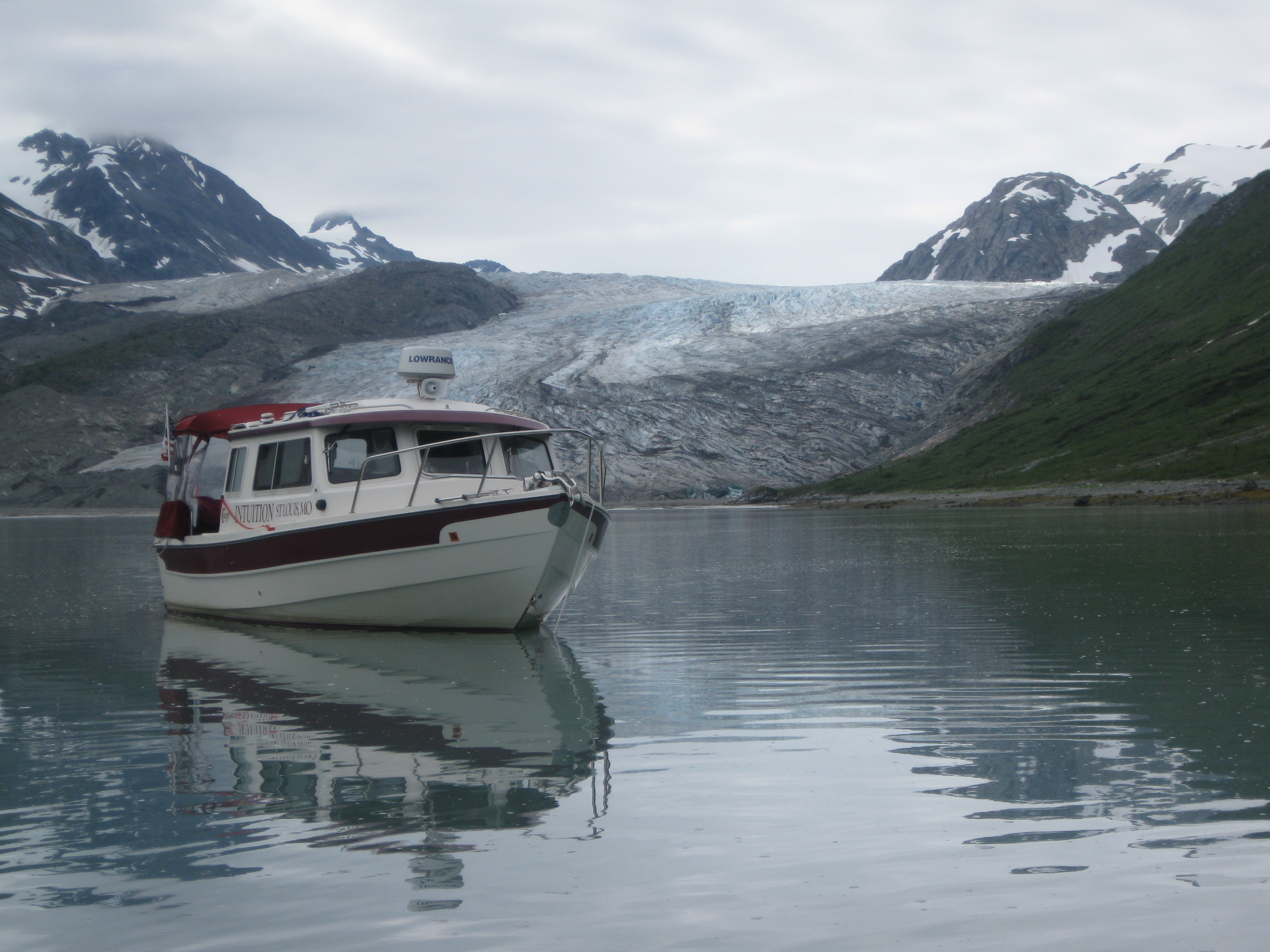
Intuition in front of Reid Glacier (Photo Credit: Les Rohlf)
Words by Les and Kel Rohlf (more photos will be on Kel’s FB or added here later when internet is stronger…)
Les’ Notes
Monday, July 26, 2021
Hoonah to Shag Cove
Miles: 65
Hours: 9.3
We left Hoonah’s harbor at 6:30am to head toward Glacier Bay. My plan was to stop at the Visitor Center in Bartlett Cove at around 10:00am. After spending an hour or two we could take advantage of the flood tide for most of our run up the bay to the planned anchorage at Shag Cove.
We got a little later start than planned, so ran plane after entering Icy Strait. We cruised at 15-16mph until a few miles short of the Glacier Bay boundary when the motor’s overheat warning came on. We stopped and bobbed around in the thankfully calm Icy Strait while we accomplished some rudimentary troubleshooting. There was no obvious obstruction on the cooling intakes; I also re-checked the oil and prop and saw no immediate issues. We restarted the motor, noted a good tell-tale from the cooling system. We continued for a while at slower speed, then at 15 mph for a few more miles without incident. Glacier Bay requires everyone entering or exiting the park boundary (a line between Point Gustavus and Point Carolus) to inform them via radio. Glacier Bay then provides the latest speed and operating restrictions for the whale protection areas in the south bay. We arrived at the Bartlett Cove public dock at 10:45am. We checked in with the rangers at the Visitor Information Station. Kel found out that Ryan, the ranger on duty is from St, Charles, MO.
Checked out the Healing Pole, Tlingit Community House, and whale skeleton outdoor exhibits. We then walked to visitor center in Glacier Bay Lodge; and went through their well-done displays. We left Bartlett Cove at 12:15pm and enjoyed the peak of the flood tide as we went through Sitakaday Narrows. With a throttle setting that normally gives us 6-7 mph, we saw 13-14.
As we continued north we saw numerous whales north of the “Whale Protection Zone.” We arrived at Shag Cove by 5:00pm, and were challenged to find a good place to drop the anchor, get enough scope, and keep a reasonably swing radius. We had to retry after the first drop.
Tonight, there’s a light NW wind, and we’ve got an annoying wave action hitting us on the beam as we swing with the tide at anchor. I imagine a strong north wind would make things uncomfortable. I can’t complain too much, as the scenery is spectacular.
Tuesday, July 27, 2021
Shag Cove to Reid Inlet
Miles: 68
Hours: 10.5
It was perfectly calm when we left Shag Cove at 6:00 am. As we headed north in the main bay, I looked up and saw an AIS contact behind us going 18 knots. Toggling to get information, the boat name was “Nieuw Amsterdam”. Looking over my right shoulder, it was clear from 7 miles away that this was a big cruise ship (Holland America Line). They passed us at a distance of 1.5 miles as we approached Blue Mouse Cove. At least at 1.5 miles, the wake involved only big slow rollers.
We continued up the Johns Hopkins Inlet. They don’t allow cruise ships into the inner part of the inlet, so the big cruise ship and two smaller Nat Geo ships were on their way out by the time we got there. The Johns Hopkins Glacier is impressive – you see it as you turn the corner into the inner section of the outlet from about 5 miles. We weren’t able to get any closer than about 3 mile due to ice.
We headed out of Johns Hopkins Inlet and decided to go ahead and run up the Tarr Inlet today, rather than waiting until tomorrow. Our timing was good, as the Holland America ship was departing the inlet as we approached, along with one of the Nat Geo ships. By the time we got to the head of the inlet, it was just us and Carte Blanche, 160 foot cruiser. We got within about a mile of the face before we started getting hemmed in by the ice as the flood tide started.
We found a decent anchoring spot in Reid Inlet beside two sailboats. This is a fairly unique and stunning anchorage with the face of a glacier just a couple miles away.
We grilled chicken for dinner, then at about 9:00 pm, a moose emerged from the brush at the point just north of our anchorage. She wandered around for a short while before becoming spooked and running back into the thicket.
Wednesday, July 28, 2021
Reid Inlet to Berg Bay
Miles: 41
Hours: 4.5
We slept in and pulled the dinghy off the roof about 8:30am this morning. We loaded everything and headed for the Reid Glacier to see how close we could get. As we headed up the inlet, a large inflatable from “Kruzof Explorer” entered the inlet. They sped up the bay and unloaded a dozen people on the southwest corner of the inlet, and we crossed to the other side and beached our tender on the southeast corner. Low tide was a couple hours away, so we pulled the dinghy out of the water and tied an extra line to a rock a little higher up.
The Reid Glacier is not a tidewater glacier and ends on a rocky, silty flat. It was a good half mile walk at low tide across the rocky flat to near the glacier face. Two fast and high streams kept us and the other group from being able to walk up to the face itself, but I think we were within a hundred yards or so. We took a bunch of pictures and marveled at how big it is close up.
I wrestled the dinghy back on top of the boat, and we departed Reid Inlet toward the south at 1:30 pm. Today there was ice in the channel for a few miles south of Reid Inlet, while yesterday we had to travel several miles farther north up the Johns Hopkins and Tarr Inlets before we saw any significant ice. We took our time going south and enjoyed watching several whales, porpoises, and sea otters.
We needed to enter Berg Bay at around high slack, as the narrow entrance is shallow with strong currents. Berg Bay is where John Muir first setup shop during his exploration of Glacier Bay in 1879. We arrived a few minutes early, waited a moment for the whale transiting across the entrance, and entered Berg Bay to find… river otter haven. There must have been 100 otters in the bay, all of whom seemed slightly curious as we motored toward the north end of the bay looking for a good anchorage. They seemed less interested once we dropped the anchor.
I grilled burgers for dinner, while Kel made fried mac and cheese balls. It’s very calm here, and the sea state has been effectively calm for our three days in Glacier Bay. The otters have quieted down and there are a couple porpoises making regular circuits of the bay. Tomorrow’s the last day on our permit here, so we’ll be heading back to Hoonah. I had wanted to see Dundas Bay, Elfin cove, and Pelican; however, we’re at a point where we need to make some choices about where to visit during our remaining time in Alaska. We want time to explore Sitka and several bays along the east side of Baranof Island, so we’ll stock up again in Hoonah tomorrow and start toward Sitka on Friday.
Kel’s Musings
We covered 160 miles over three days exploring Glacier Bay National Park. When we crossed the line on the map saying that we entered the park, I snapped a photo. We were welcomed by a parade of sea otters floating on their backs, looking quite relaxed. Coming into the park, little did we know that much of what makes Alaska stunning can be seen while touring around on the waterways. Of course, if you choose to hike in the forest or kayak in the backwaters, you’d see even more. The park encompasses 1500 square miles including forested land, mountains and glaciers to name just a few land forms. We saw sea otters, humpback whales, harbor porpoises, river otters, and various kinds of water birds, and the lone moose in Reid Inlet. Even though we had seen much of this scenery and wildlife along our travels to experience it all in one place was pretty spectacular.
Photos and words cannot even begin to describe this amazing national treasure, and also the story of how the Tlingit people and the National Park Service chose to be honest about their struggle and misunderstandings about the use of the land over the years. To see the totem dedicated to healing the relationship was a witness to the possibility of coming to terms with past hurts and moving toward a more meaningful relationship.
Before entering the park, we watched an orientation video to prepare us for our visit. A Tlingit Elder spoke as a voice for the land welcoming us to Glacier Bay. He said on behalf of Nature, “I look forward to seeing your face.” The phrasing struck a chord within me, and I felt welcomed and eager to meet the “voice” that longed for us to be there. I truly felt that getting a chance to go into the park was slight, and when we got the permit to go, I was thankful to God for providing us the opportunity.
Only 25 boats are allowed in the park at a time, so it was very quiet, and except for navigating with the cruise ships and tour boats, we really had the place to “ourselves” most of the time. There is a lodge and cabins, if you ever wanted to visit by land.
We saw four glaciers up close, as well as the Grand Pacific Glacier and Rendu from a distance. The first one we passed was Reid, and when Les said that we would be anchoring near it, I almost fell off my perch. I didn’t know we could do that. Next we went up the inlet towards Johns Hopkins Glacier, which the cruise ships were circling by, but as Les mentioned could not go up towards it. We rounded a corner, and I thought we had arrived at the glacier, but it was yet another one called Lamplugh. Johns Hopkins and Margerie were the only two that we saw that still calved right into the water. Reid and Lamplugh ended just short of the water with a rocky and silt beach in front of them. We didn’t see any calve this time, but I did collect some bergie bits from the three main ones that we approached, which were Johns Hopkins, Margerie and Reid.
Taking the dinghy over to the Reid Glacier was a highlight of our time in Glacier Bay. The sheer mass overwhelms and awes you at the same time. I really wanted to touch the glacier, and the closest I got was to sitting on one of the icebergs that were beached in front of the glacier, and that was pretty amazing. Watching little rocks slip off, and the trickle of water melting off the face of the glacier made me realize that it was time to retreat. Respect truly was what I felt for the glacier. It thrilled me to be so near it, but also caused my soul to tremble a bit as well.
We hiked back to the dinghy and just kept marveling that we had this experience. Some days it just seems so surreal that we are really here. Les even said that he kept wondering if we’d really ever make it to Alaska, and here we are! What a gift! We had time to get down to our next anchorage, and just as we left the sun broke through the morning haze. I made us lunch while we motored south to our next anchorage. It was called Berg Bay, so I asked Les if we were anchoring by another glacier. Nope, it’s just the bay where John Muir camped when he explored here in 1879. On our way we saw a mother and young sea otter floating together. And more whale sightings. Just too incredible.
We pulled into the cove, and the guide book said there was a “Nifty Nook” to anchor in past one of the islands. Les asked if I felt like checking it out. At first, I hesitated because we had seen a whale on the way in, and maybe it would come near our anchorage if we stayed out closer to the entrance of the cove. But for some reason, maybe because it was called the “Nifty Nook,” my curiosity voted to go further in. When neared the island and saw all the otters (a mixture of sea and river otters) we were a bit surprised. They seemed very curious about us, and I was a little nervous that they would hang around and “whine” all night, as they were doing when we arrived. But little by little they scurried off across the cove. I was sitting by the window, while Les grilled, and I heard what sounded like a spouting whale, but it was a harbor porpoise exhaling as it gently crested next to our boat.
The next morning, we got up early, and while Les checked the oil and got ready to take up the anchor, a feeling of keen tranquility came over me. I looked out the window and a salmon jumped and landed back on its side in the water. A few moments later an eagle swooped down, it was the first one I saw in the park. It caught something in its talons, most likely the salmon. Then instead of flying back out of the water, the eagle swam with its wings to carry the catch to shore. Astounding.
We cruised out of the cove and once again the sea otters and river otters seemed to escort us out, bobbing their heads up, and some even dove toward our boat, as if playing with us. We noticed whales spouting against the shore of an island, and a couple porpoises joined the dance of waving us off. To touch the face of a glacier, to be welcomed by the Tlingit elder and the park, every bit of our time was a wondrous gift.
Come, my heart says, seek God’s face. Lord, I do seek your face! (Psalm 27:9 CEB)
We left Hoonah late this morning, given that we were planning for a short day. I originally considered anchoring somewhere back in Port Frederick, but decided on Flynn Cove. We’re heading toward Elfin Cove and Pelican, so it’s both on the way and likely to have slightly better cell/internet connectivity.
Each day since leaving Boat Harbor we’ve submitted requests for a short-notice permit to Glacier Bay, and we’ve not been successful to date. We’ve heard several opinions of Glacier Bay ranging from “Not to be missed” to “Over-hyped and not worth the hassle.” Since we’re in the area, we figured we’d at least try, though we’re not going to wait around too long at the expense of visiting other areas.
Icy Strait was rather choppy and uncomfortable, so we stayed as close to the south shore as possible. We arrived at Flynn Cove by 2:00 pm and dropped the anchor in 45 feet as far east as we could get in the cove. Icy Strait was pretty breezy, and Flynn Cove is well-protected from any winds with an eastern component. One other smaller cruiser anchored in the cove later in the afternoon.
There were light rain showers off and on during the afternoon, and we relaxed and caught up on some reading. At about 8:30pm we saw our first bear walking along the south shore of the cove. While watching the first bear, we saw two smaller (I assume juvenile) bears walking on the eastern shoreline in the direction of the first bear. At some point they got wind of each other – the smaller two ran around to the south shore and headed west, while the first ran east into the tall grass. Perhaps realizing he (or she) was larger, he stopped, stood up, and watched the two smaller bears run away. He then came back toward the shore and munched on grass as he continued around to the eastern shore from whence the smaller two had appeared.
Saturday, July 24
Flynn Cove to Hoonah
Miles: 12
Hours: 3.1
Sometimes the schedule changes for weather; sometimes schedules change for mechanical issues, and sometimes… other things happen to adjust the schedule.
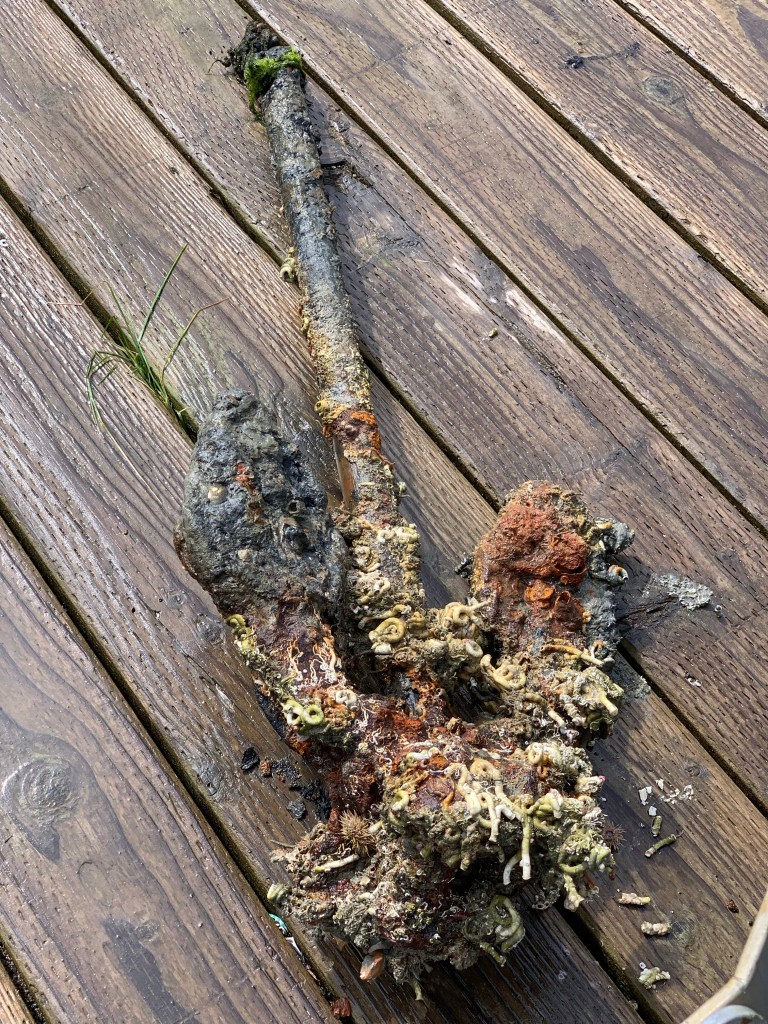
We slept in a little this morning, ate breakfast, and I hit <enter> at 7:59:58 am to submit today’s Glacier Bay permit request. Following our normal process, I (Les) stood on the bow, untied the separate snubber line that connects the rode to the bow eye, then unwound the rode from the center bow cleat. I watched the chain come up as Kel ran the windlass from the helm. I noticed it looked kind of funny as it neared the surface. We stopped the windlass as the anchor broke the surface and saw this:
Our anchor holds another anchor
Our anchor had snagged an (old) anchor from the bottom of Flynn Cove. I tried unsuccessfully to dislodge it with a boat hook. The anchor was larger (and heavier) than ours and was tightly wedged around the shank of ours. Standing over the end of the bow is a little precarious to begin with, and I didn’t have enough leverage to either untangle them or pull the entire mess onto the bow.
After fiddling for a while, I managed to lasso the long shank of our feral anchor with a dock line, ran the line through a chock, and tied it to the center bow cleat. This would at least keep the heavy mess from swinging around and smashing into the hull of the boat. I then got a hook onto the chain and tied it around the bow rail to hopefully relieve some of the stress on the windlass.
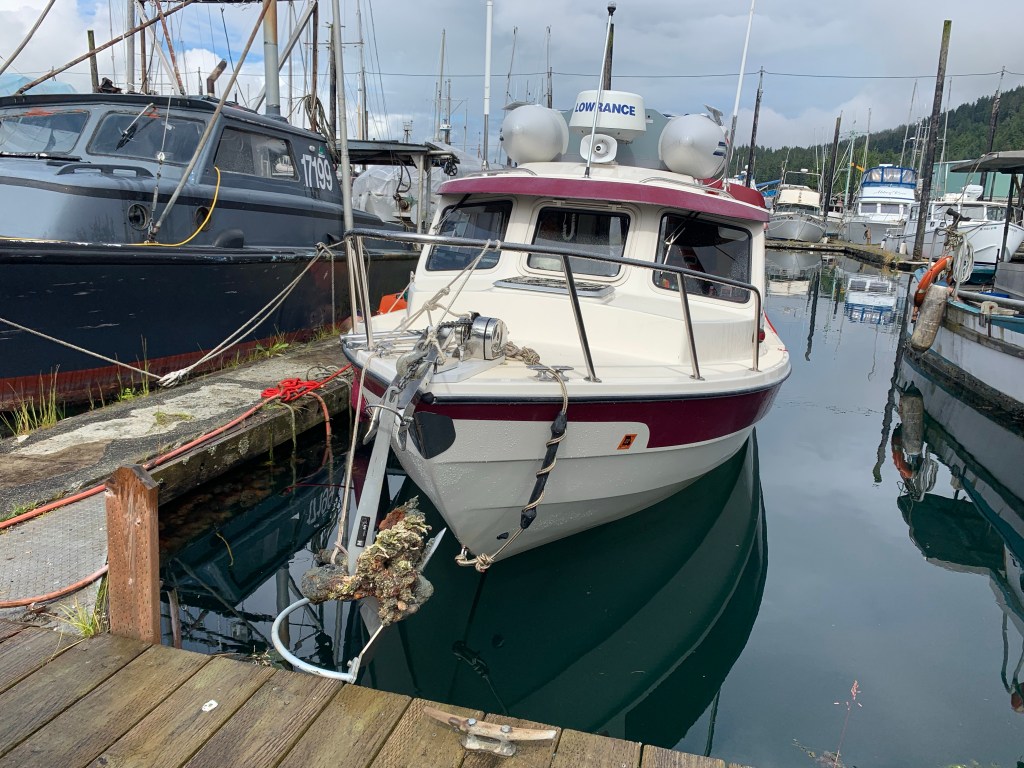
Our plan for today had been to go the Elfin Cove. If no dock space were available there, we’d continue on toward Pelican. Given the extra (marginally secured) weight dangling from my bow roller, I really didn’t like the idea of running another 20 miles west on a lumpy Icy Strait, followed by potentially higher waves in the section of Cross Sound we’d pass en route to Elfin Cove. The easy answer was to slowly limp back the 12 miles to Hoonah, where we could dock the boat and work on the bow from a stable platform. Fortunately, Icy Strait was a little less boisterous than yesterday. We made our way back at 5-6 mph and pulled into the same slip we left yesterday morning. Once we secured the boat and untied the lines that secured the anchors, we could let out rode via the windlass and perform an anchor-ectomy on the dock. The anchor was indeed bigger and heavier than ours – I’m guessing 35+ lbs. The good news – we managed to get back here and separate everything without hurting ourselves or Intuition. The windlass and anchor roller hauled up the 60 or so pounds of anchor (and 50’ of chain) without complaint, and are apparently no worse for wear after separating everything on the dock.
I deposited the old anchor and all its attached marine organisms at the top of the marina walkway next to the dumpsters. Kel mentioned it to the dockmaster and a lady at the souvenir shop across the street – the anchor was gone within an hour.
After settling in, we received notice from Glacier Bay that we have a permit for 7/26-7/29. Our plan now is to prepare and provision here in Hoonah through tomorrow, and head to Elfin Cove and Pelican after our time in Glacier Bay.
Kel’s Musings
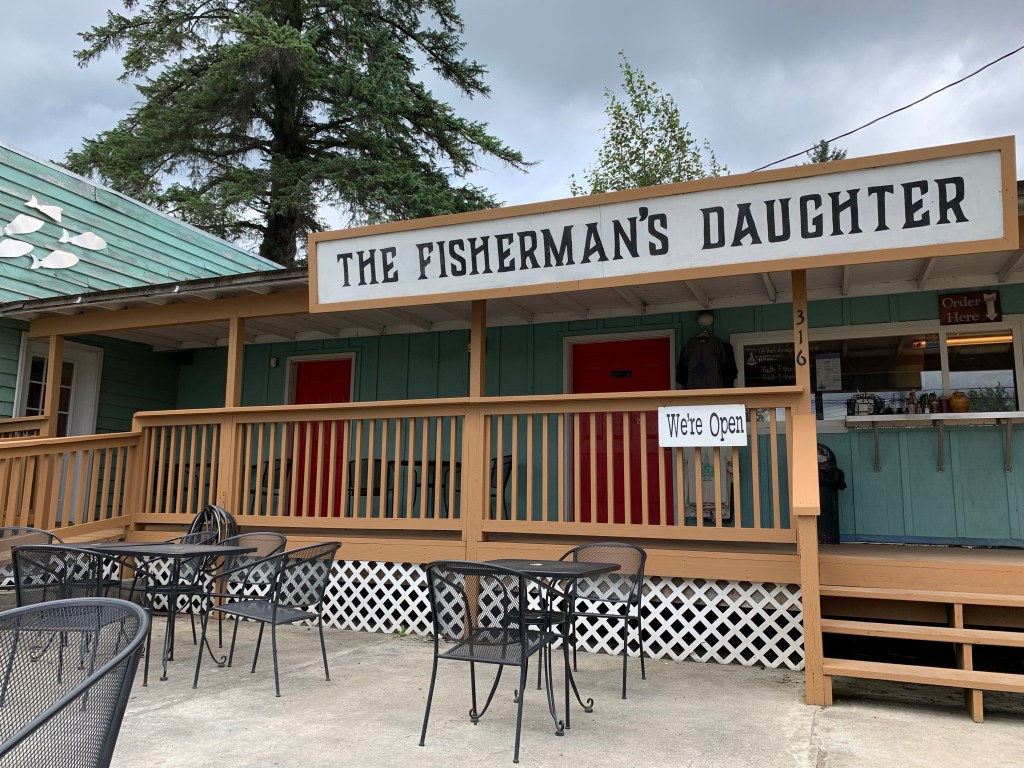
Hoonah is a small, friendly community with one great restaurant, The Fisherman’s Daughter. On Thursday, we ate dinner there. Les had a scrumptious burger with deep fried mac n cheese on top, and I enjoyed halibut “nuggets” with a curry soup as a side. We sat outside watching the town folks walk by or come up and order a cup of soup to go. On Friday, we ate breakfast there.
We heard through the grapevine that the first cruise ship of the season was arriving, and noticed locals making their way to the other end of town to sell their wares to the cruise guests. Everyone seemed pretty matter of fact about the whole thing. The harbormaster mentioned that not everyone was excited to have the cruise line return. We decided to stay on this end of town near the grocery store, marina and other local shops. From what we could tell the cruise guests stay down at the Icy Strait Point to take side trips to see bears or whales, and buy local goods and souvenirs.
At first, I thought we would go see the touristy attractions by the cruise dock, but instead we decided to buy a few groceries, and head out the next day to check out a couple other places nearby. I sort of wanted to stay in Hoonah another night, but it turned out to be an interesting anchorage in Flynn Cove. After dinner we watched the shore to see if any bears would grace us with their presence. I really didn’t think we’d see any, and was surprised to see an animal loping along the shore. I alerted Les, and at first we weren’t sure if it was a bear, but the binoculars confirmed our sighting. I had just finished the dishes and they were drying near the window where we could see the bear. I quickly pulled out my camera, knocked some dishes over, and then put the dishes to the side so I could get a closer look. The bear turned its head toward us, as if to say who’s making all that racket? We did get a couple decent pictures, and had fun watching the interaction between the other two bears that came along. Once again, we were in awe of our good fortune of getting to see wildlife on our own. (To see photos of bears and whale sightings check out Kel’s FB page)
As Les mentioned the anchor experience brought us back to Hoonah. Once we got the situation sorted, and found out we got the permit for Glacier Bay, we decided to stay in Hoonah for the weekend.
So what is there to do in Hoonah over a weekend, besides our routine chores? Walk in the rain to check out the gift shops, shop at the local, small “Costco” store with bulk food for sale (aka Collette’s Cupboard), continue to walk in the rain about a mile to the hardware store to buy a geranium (I love greenery on the boat, what can I say?) I also bought a little step stool to get up into my perch. I had a shorter one that works as a good footstool when I sit at the table. Creature comforts matter when you’re seating arrangements are limited. I carried all my purchases, two bags and the stool, back the mile in the rain to our boat. It was a good afternoon walk. It rained most of the day and evening, and we were a bit wore out from the anchor incident, so we had dinner at The Fisherman’s Daughter. (Beef and barley soup was wonderful on a chilly, wet evening.) Apparently the locals thought so as well.
We were entertained by people watching. A young man with a stroller brought his toddler to say hello to friends and to the little girl’s mother who was working in the restaurant kitchen. A barefooted young woman with a child dressed in his dinosaur costume and two little girls arrived. We overheard teenagers say they were going to the open swim at the local indoor pool. Another young man came up the walk whistling bird calls, and asked if we were from Juneau? He was a nature tour guide and EMT. He said business was slow, so he had been out fishing. He offered us his services as a taxi driver. He told us his name was Jack Diamond.
After dinner we walked over to see the newly installed totem pole dedicated to Hoonah veterans. A rainbow graced us with its presence. We walked back to the boat, once again in awe of this place. And tomorrow…Glacier Bay National Park!!!
“God is all mercy and grace— not quick to anger, is rich in love.” (Psalm 145:8 The Message)













 Intuition Diaries